Concentration Camp AUSCHWITZ metal token ID for forced labor inmate
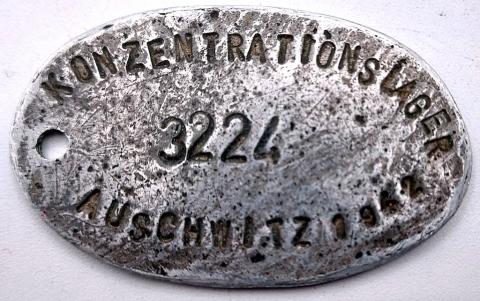
Concentration Camp AUSCHWITZ metal token ID for forced labor inmate
$175.00
Product
Concentration Camp AUSCHWITZ metal token ID for forced labor inmate
Empty
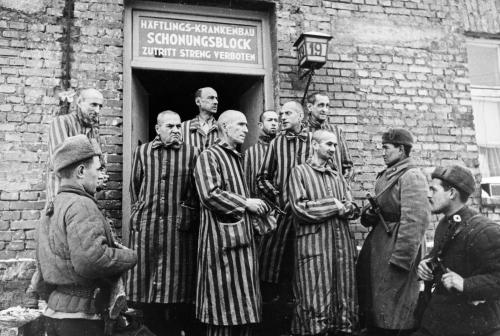
In the course of the war, the camp was staffed by 6,500 to 7,000 members of the German Schutzstaffel (SS), approximately 15 percent of whom were later convicted of war crimes. Some, including camp commandant Rudolf Höss, were executed. The Allied Powers refused to believe early reports of the atrocities at the camp, and their failure to bomb the camp or its railways remains controversial. One hundred and forty-four prisoners are known to have escaped from Auschwitz successfully, and on October 7, 1944, two Sonderkommando units—prisoners assigned to staff the gas chambers—launched a brief, unsuccessful uprising.
As Soviet troops approached Auschwitz in January 1945, most of its population was evacuated and sent on a death march. The prisoners remaining at the camp were liberated on January 27, 1945, a day now commemorated as International Holocaust Remembrance Day. In the following decades, survivors such as Primo Levi,Viktor Frankl, and Elie Wiesel wrote memoirs of their experiences in Auschwitz, and the camp became a dominant symbol of the Holocaust. In 1947, Poland founded a museum on the site of Auschwitz I and II, and in 1979, it was named a UNESCO World Heritage Site.
The ideology of Nazism brought together elements of antisemitism, racial hygiene, and eugenics, and combined them with pan-Germanism and territorial expansionism with the goal of obtaining more Lebensraum (living space) for the Germanic people.[10] Nazi Germany attempted to obtain this new territory by attacking Poland and the Soviet Union, intending to deport or kill the Jews and Slavs living there, who were viewed as being inferior to the Aryan master race.[11] After the invasion of Poland in September 1939,
German dictator Adolf Hitler ordered that the Polish leadership and intelligentsia should be destroyed.[12] Approximately 65,000 civilians were killed by the end of 1939. In addition to leaders of Polish society, the Nazis killed Jews, prostitutes, Romani, and the mentally ill.[13][14] SS-Obergruppenführer (Senior Group Leader) Reinhard Heydrich, then head of the Gestapo, ordered on September 21 that Jews should be rounded up and concentrated into cities with good rail links. Initially the intention was to deport the Jews to points further east, or possibly to Madagascar.[15]
Concentration Camp AUSCHWITZ metal token ID for forced labor inmate
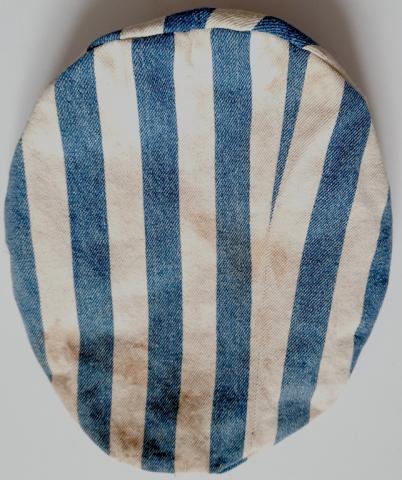
Concentration camp AUSCHWITZ BIRKENAU survivor inmate uniform CAP HAT
comes from the relatives of a survivor, extremely rare to find, a museum piece !
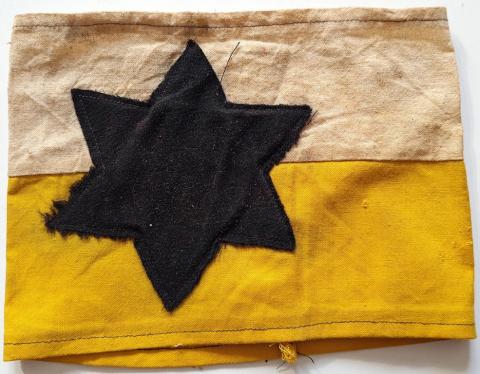
SCARCE Holocaust JEWISH GHETTO POLICE JUDENRAT ARMBAND with a black Star of David jew getto polizei
known pattern, 10000% original, impossible to find !!!!
perfect for a museum !
The Jewish Ghetto Police or Jewish Police Service, also called the Jewish Police by Jews, were auxiliary police units organized within the Nazi ghettos by local Judenrat (Jewish councils).
Members of the Jewish Police did not usually have official uniforms, often wearing just an identifying armband, a hat, and a badge, and were not allowed to carry firearms, although they did carry batons. In ghettos where the Judenrat was resistant to German orders, the Jewish police were often used (as reportedly in Lutsk) to control or replace the council. One of the largest Jewish police units was to be found in the Warsaw Ghetto, where the Jüdischer Ordnungsdienst numbered about 2,500. The Łódź Ghetto had about 1,200, and the Lwów Ghetto 500.
Anatol Chari, a policeman in the Łodz Ghetto, in his memoirs describes his work protecting food depots, controlling bakery employees, as well as patrols aimed at the confiscation of food from the ghetto residents. He recounts the involvement of Jewish policemen in swindling food rations and in forcing women to provide sexual services in exchange for bread. The Polish-Jewish historian and Warsaw Ghetto archivist Emanuel Ringelblum has described the cruelty of the ghetto Jewish police as "at times greater than that of the Germans, the Ukrainians and the Latvians." The Jewish ghetto police ultimately shared the same fate with all their fellow ghetto inmates. On the ghettos' liquidation (1942–1943), they were either killed on-site or sent to extermination camps.
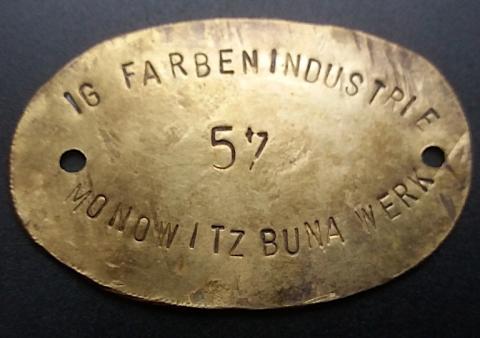
WW2 GERMAN NAZI CONCENTRATION CAMP AUSCHWITZ III MONOWITZ I.G FARBEN INDUSTRIES ID PLATE
USED TO ID A MACHINE OR ANYTHING THAT NEEDED TO BE NUMBERED...
BAYER, COMPANY THAT MADE ZYKLON B GAS, MANY COMPANIES HAD THEIR FABRIK THERE AND THEY WERE USING INMATES FROM AUSCHWITZ TO WORK - FORCED LABOUR.
Monowitz-Buna WAS AN AUSCHWITZ III SUBCAMP
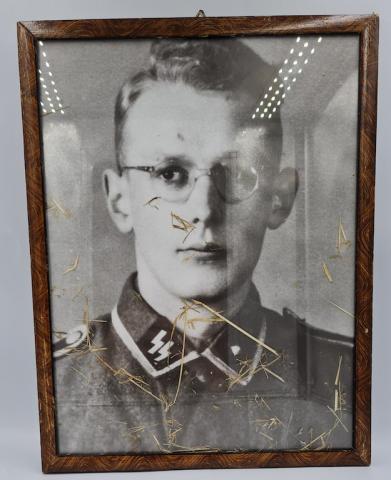
Oskar Groning Waffen SS portrait frame photo SS Unterscharführer who was stationed at the Auschwitz concentration camp accounting
amazing piece of history !!
size: 42cm X 32,5cm
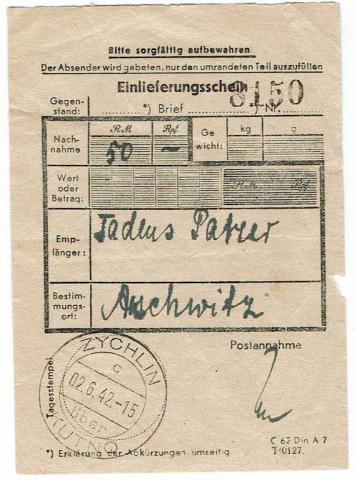
Concentration camp Auschwitz Birkenau inmate's public transfer notice document KL KZ
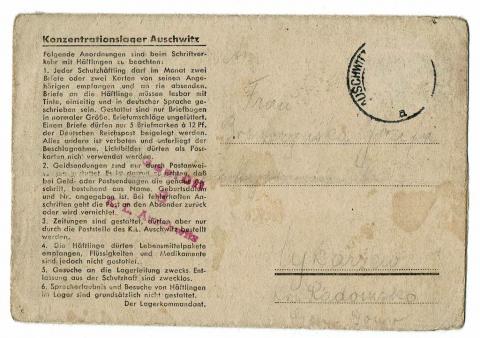
Concentration camp AUSCHWITZ BIRKENAU inmate personal letter feldpost stamped dated
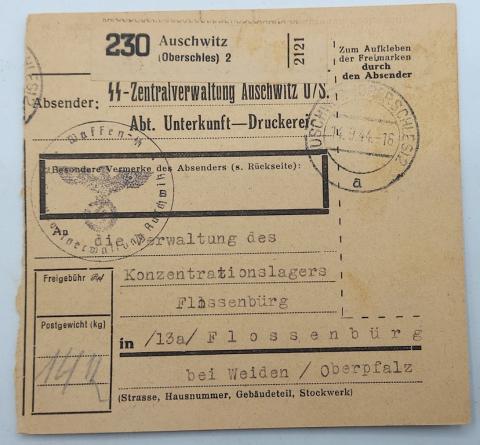
Concentration camp Auschwitz transfer of a Waffen SS totenkopf guard to another camp document signed and stamped
very nice SS - auschwitz document which is EXTREMELY rare and HISTORICAL.
stamped SS & signed by a SS officer
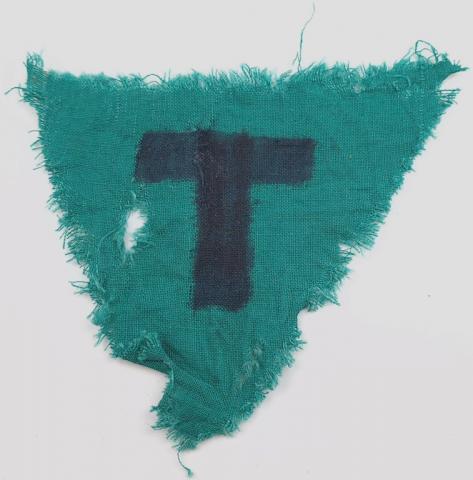
WW2 Holocaust RARE concentration camp Czech inmate criminal green triangle T patch uniform
green = criminal
T = Czech
RARE and AMAZING piece of HISTORY !
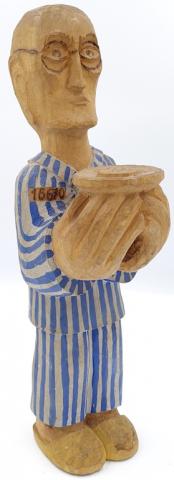
Concentration Camp AUSCHWITZ Kolbe wooden statue made by a survivor with uniform and patches
what an AMAZING AND UNIQUE PIECE OF HOLOCAUST HISTORY !
Maximilian Maria Kolbe (born Raymund Kolbe; Polish: Maksymilian Maria Kolbe [maksɨˌmʲilʲan ˌmarʲja ˈkɔlbɛ]; 8 January 1894 – 14 August 1941), venerated as Saint Maximilian Kolbe, was a Polish Catholic priest and Conventual Franciscan friar who volunteered to die in place of a man named Franciszek Gajowniczek in the German death camp of Auschwitz, located in German-occupied Poland during World War II. He had been active in promoting the veneration of the Immaculate Virgin Mary, founding and supervising the monastery of Niepokalanów near Warsaw, operating an amateur-radio station (SP3RN), and founding or running several other organizations and publications.
On 10 October 1982, Pope John Paul II canonized Kolbe and declared him a martyr of charity. The Catholic Church venerates him as the patron saint of amateur radio operators, drug addicts, political prisoners, families, journalists, and prisoners. John Paul II declared him "The Patron Saint of Our Difficult Century." His feast day is 14 August, the day of his death.
Due to Kolbe's efforts to promote consecration and entrustment to Mary, he is known as the Apostle of Consecration to Mary.
On 17 February 1941, the monastery was shut down by the German authorities.[2] That day Kolbe and four others were arrested by the Gestapo and imprisoned in the Pawiak prison.[2] On 28 May, he was transferred to Auschwitz as prisoner 16670.[24]
Maximilian Kolbe, on a West German postage stamp, marked Auschwitz
Continuing to act as a priest, Kolbe was subjected to violent harassment, including beatings and lashings. Once he was smuggled to a prison hospital by friendly inmates. At the end of July 1941, one prisoner escaped from the camp, prompting SS-Hauptsturmführer Karl Fritzsch, the deputy camp commander, to pick ten men to be starved to death in an underground bunker to deter further escape attempts. When one of the selected men, Franciszek Gajowniczek, cried out, "My wife! My children!" Kolbe volunteered to take his place.
According to an eyewitness, who was an assistant janitor at that time, in his prison cell Kolbe led the prisoners in prayer. Each time the guards checked on him, he was standing or kneeling in the middle of the cell and looking calmly at those who entered. After they had been starved and deprived of water for two weeks, only Kolbe remained alive.
Death
The guards wanted the bunker emptied, so they gave Kolbe a lethal injection of carbolic acid. Kolbe is said to have raised his left arm and calmly waited for the deadly injection. He died on 14 August 1941. His remains were cremated on 15 August, the feast day of the Assumption of Mary.
