Empty

Total: $0.00

Auschwitz

Discrimination against Jews began immediately after the Nazi seizure of power in Germany on January 30, 1933. The Law for the Restoration of the Professional Civil Service, passed on April 7 that year, excluded most Jews from the legal profession and the civil service. Similar legislation soon deprived Jewish members of other professions of the right to practise.[3] Violence and economic pressure were used by the regime to encourage Jews to leave the country voluntarily.[4] Jewish businesses were denied access to markets, forbidden to advertise in newspapers, and deprived of access to government contracts. Citizens were harassed and subjected to violent attacks and boycotts of their businesses.[5] In September 1935 the Nuremberg Laws were enacted. These laws prohibited marriages between Jews and people of Germanic extraction, extramarital relations between Jews and Germans, and the employment of German women under the age of 45 as domestic servants in Jewish households.[6] The Reich Citizenship Law stated that only those of Germanic or related blood were defined as citizens. Thus Jews and other minority groups were stripped of their German citizenship.[7] By the start of World War II in 1939, around 250,000 of Germany's 437,000 Jews emigrated to the United States, Palestine, Great Britain, and other countries.[8][9]

In the course of the war, the camp was staffed by 6,500 to 7,000 members of the German Schutzstaffel (SS), approximately 15 percent of whom were later convicted of war crimes. Some, including camp commandant Rudolf Höss, were executed. The Allied Powers refused to believe early reports of the atrocities at the camp, and their failure to bomb the camp or its railways remains controversial. One hundred and forty-four prisoners are known to have escaped from Auschwitz successfully, and on October 7, 1944, two Sonderkommando units—prisoners assigned to staff the gas chambers—launched a brief, unsuccessful uprising.

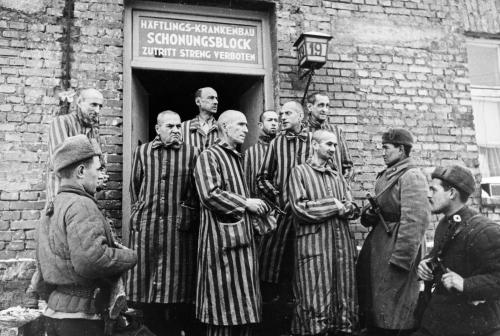
As Soviet troops approached Auschwitz in January 1945, most of its population was evacuated and sent on a death march. The prisoners remaining at the camp were liberated on January 27, 1945, a day now commemorated as International Holocaust Remembrance Day. In the following decades, survivors such as Primo Levi,Viktor Frankl, and Elie Wiesel wrote memoirs of their experiences in Auschwitz, and the camp became a dominant symbol of the Holocaust. In 1947, Poland founded a museum on the site of Auschwitz I and II, and in 1979, it was named a UNESCO World Heritage Site.

The ideology of Nazism brought together elements of antisemitism, racial hygiene, and eugenics, and combined them with pan-Germanism and territorial expansionism with the goal of obtaining more Lebensraum (living space) for the Germanic people.[10] Nazi Germany attempted to obtain this new territory by attacking Poland and the Soviet Union, intending to deport or kill the Jews and Slavs living there, who were viewed as being inferior to the Aryan master race.[11] After the invasion of Poland in September 1939,

German dictator Adolf Hitler ordered that the Polish leadership and intelligentsia should be destroyed.[12] Approximately 65,000 civilians were killed by the end of 1939. In addition to leaders of Polish society, the Nazis killed Jews, prostitutes, Romani, and the mentally ill.[13][14] SS-Obergruppenführer (Senior Group Leader) Reinhard Heydrich, then head of the Gestapo, ordered on September 21 that Jews should be rounded up and concentrated into cities with good rail links. Initially the intention was to deport the Jews to points further east, or possibly to Madagascar.[15]

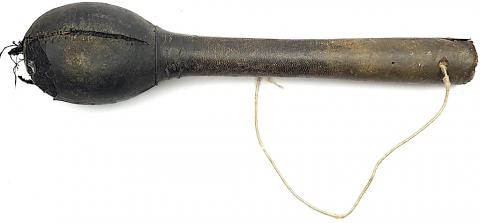
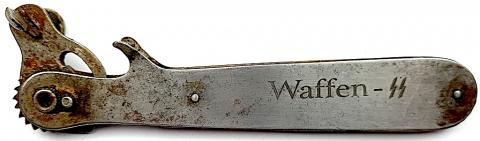
AMAZING concentration camp inmate's KAPO Truncheon used holocaust

AMAZING concentration camp inmate's KAPO Truncheon used holocaust

AMAZING concentration camp inmate's KAPO Truncheon used holocaust

$650.00

Product

AMAZING concentration camp inmate's KAPO Truncheon used holocaust

MUSEUM PIECE !!!!
one of the best concentration camp item you can get, amazing piece of history !

used by a KAPO (an inmate that was responsible for it's Barak).
image the suffering of getting beaten by a piece like that !
it was used a lot - see photos

who will get this first ??

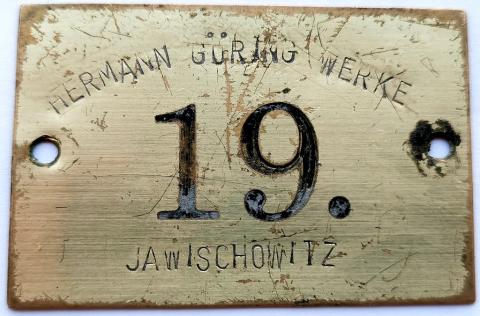
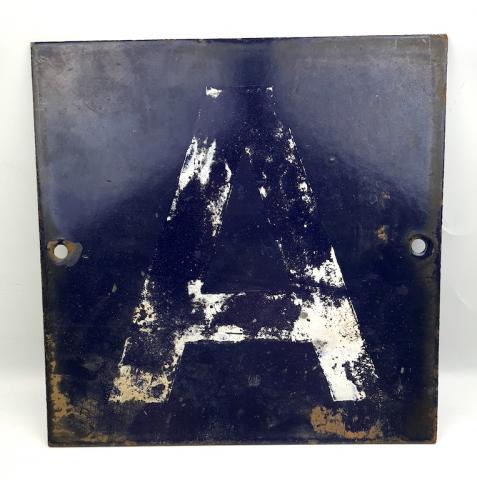
Concentration camp Auschwitz subcamp plates numbered HERMANN GORING WERKE JAWISCHOWITZ. # 19

Concentration camp Auschwitz subcamp plates numbered HERMANN GORING WERKE JAWISCHOWITZ. # 19

Concentration camp Auschwitz subcamp plates numbered HERMANN GORING WERKE JAWISCHOWITZ. # 19

$185.00

Product

Concentration camp Auschwitz subcamp plates numbered HERMANN GORING WERKE JAWISCHOWITZ. # 19

worker - inmate from that camp who worked in the Goering Fabrik, identification employee #19...

A sub-camp located in the village of Jawiszowice (in German: Jawischowitz). The prisoners held there worked in two shafts of the Brzeszcze coal mine located in the localities of Jawiszowice and Brzeszcze. The camp began functioning in mid-August 1942 when 150 French Jews arrived under an agreement between the WVHA and the Reichswerke Hermann Göring, which owned the mine. This was the first time in the history of the German concentration camps that prisoners were employed below ground. In terms of the number of prisoners, Jawischowitz was one of the largest Auschwitz sub-camps. In June 1944, it held 2,500 prisoners, mostly Jews from Poland, France, Germany, the Netherlands, Italy, and Hungary. There were also Poles, Russians, and Germans in the sub-camp.

At the turn of 1943/1944 there were at least 70 SS men in the garrison. The first director was SS-Unterscharführer Wilhelm Kowol, who was succeeded by SS-Hauptscharführer Josef Remmele. The sub-camp was surrounded by electrified barbed-wire fencing. It consisted of more than ten barracks, most of them wooden. Prisoners lived in seven of them and the rest contained a kitchen, hospital, storage space, workshops, washrooms, and toilets. Despite the expansion of the sub-camp, the prisoner rooms were overcrowded in 1944, with more than 200 men in rooms designed for 54.

The prisoners had two changes of clothes at their disposal—work clothes that they took off at the showers after their shift, and the clothes they wore in the sub-camp. Thanks to their everyday showers and changing of clothes, dictated by the nature of work in the mine, they did not suffer from the lice that were a serious problem for prisoners in other parts of the Auschwitz complex. The work in the mine exhausted them, however. They loaded carts with coal, transported them, made repairs, and did construction work in a three-shift system with quotas that they were sometimes unable to fulfill because they were hungry, weak, or did not know how to do the job. On such occasions, their shift was extended until the norms were met. Prisoners also worked above ground at various sorts of construction jobs. In the second half of 1944, several score underage Jewish prisoners were assigned to sort the coal.

SS doctors held selection every few weeks, after which the prisoners classified as unfit for labor were taken to Auschwitz. Most of them were murdered in the gas chambers there. According to partially extant records from October 1942 to December 1944, at least 1,800 sick prisoners were removed from Jawischowitz.

In January 1945, about 1,900 prisoners were evacuated on foot to Wodzisław Śląski. Several score sick and exhausted prisoners were left behind; Soviet soldiers liberated the majority of them on January 29. After liberation they were taken into the care of the local branch of the Polish Red Cross.
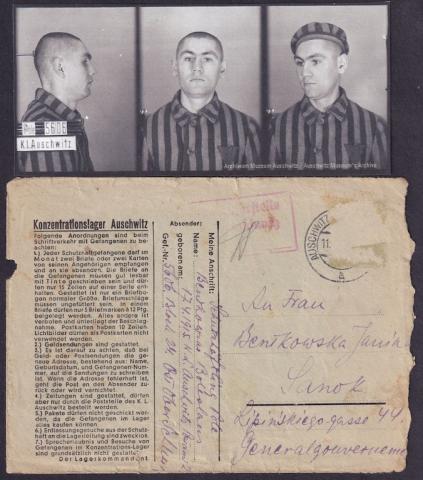
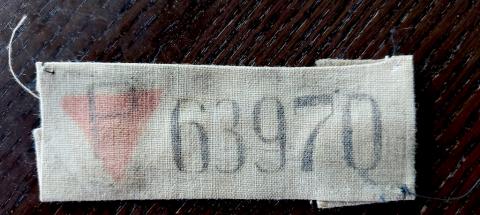
Concentration camp AUSCHWITZ young inmate uniform jacket PATCH ID with P red triangle

Concentration camp AUSCHWITZ young inmate uniform jacket fully researched PATCH ID with P red triangle

Concentration camp AUSCHWITZ young inmate uniform jacket PATCH ID with P red triangle

$450.00

Product

Concentration camp AUSCHWITZ young inmate uniform jacket PATCH ID with P red triangle

see last photo for the mug photo of that inmate.
he wears a patch from another camp as he was transfered and these photos are taken upon arrival in the camp...

amazing piece of history !
try to find another one from that camp ??

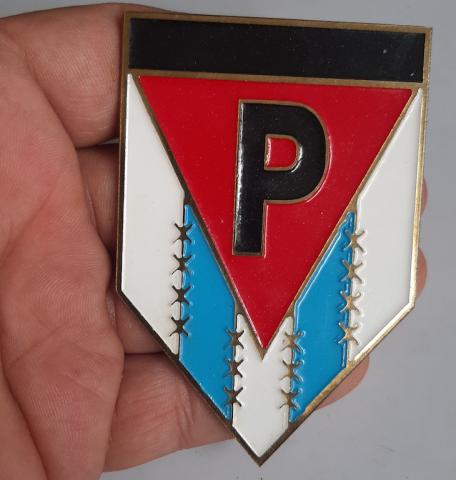
WW2 GERMAN NAZI HOLOCAUST CONCENTRATION CAMP AUSCHWITZ LARGE SURVIVOR POLITICAL PRISONER CELEBRATION OF LIBERATION WALL PLATE

WW2 GERMAN NAZI HOLOCAUST CONCENTRATION CAMP AUSCHWITZ LARGE SURVIVOR POLITICAL PRISONER LIBERATION WALL PLATE

WW2 GERMAN NAZI HOLOCAUST CONCENTRATION CAMP AUSCHWITZ LARGE SURVIVOR POLITICAL PRISONER CELEBRATION OF LIBERATION WALL PLATE

$135.00

Product

WW2 GERMAN NAZI HOLOCAUST CONCENTRATION CAMP AUSCHWITZ LARGE SURVIVOR POLITICAL PRISONER CELEBRATION OF LIBERATION WALL PLATE

100% original, LARGE
AMAZING FOR DISPLAY
EXTREMELY RARE TO FIND AS IT WASN'T GIVEN TO INMATES BUT IT WAS USED ON WALLS IN THE PLACE WHERE THE SURVIVOR - LIBERATION COMMEMORATIVE CEREMONY WAS GIVEN.

Pages

Subscribe to RSS - Auschwitz