Empty

Total: $0.00

IMPERIAL WW1 GERMAN PRUSSIAN OFFICER PICKELHAUBE SPIKE HELMET
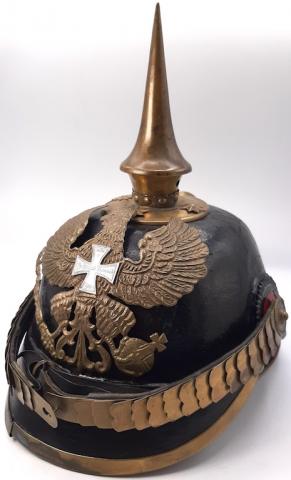
IMPERIAL WW1 GERMAN PRUSSIAN OFFICER PICKELHAUBE SPIKE HELMET

IMPERIAL WW1 GERMAN PRUSSIAN OFFICER PICKELHAUBE SPIKE HELMET

$695.00

Product

(Pickelhaube). This helmet is constructed from polished black leather, re-finished, with mild crazing throughout, the exterior stitching remaining intact, it has solid polished metal fittings, which includes the spike (with two ventilation holes and an ornate design at the base), with spike mounting base (with four eight-pointed star pins), rear spine, front visor trim and chin strap (multi-scaled with sliding lock), there is a three-colour cockade of Imperial Germany on the right side and a black cockade representing Prussia on the left side, with original capped pins connecting to the brass chin strap, which is supported by an intact underlying leather chin strap, with central buckle for adjustment, the helmet plate is brass with the Prussian eagle insignia, the eagle bearing a shield on its chest with the cipher of King Frederick, with a silver Iron Cross inscribed MIT GOTT FUR KOENIG UND VATERLAND 1813 (With God for King and Country 1813), the underside of the visor is lined in green, while the underside of the neck guard is lined in red, the inside is lined in brown leather, with a retractable two-piece synthetic liner with wire supports in the dome
WAR PERIOD GMBH GERMANY Vintage Maggi Seasoning Brown Anchor Hocking Glass Bottle

WAR PERIOD GMBH GERMANY Vintage Maggi Seasoning Brown Anchor Hocking Glass Bottle

WAR PERIOD GMBH GERMANY Vintage Maggi Seasoning Brown Anchor Hocking Glass Bottle

$20.00

Product

WAR PERIOD Vintage Maggi Seasoning Brown Anchor Hocking Glass Bottle
FROM Singen, Germany.

The company originated in Switzerland in 1884, when Julius Maggi took over his father's mill. He quickly became a pioneer of industrial food production, aiming to improve the nutritional intake of worker families. Maggi was the first to bring protein-rich legume meals to the market, and followed up with a ready-made soup based on legume meals in 1886. After that Julius Maggi introduced bouillon concentrates, first in capsules, then in cubes. In 1897, Julius Maggi founded the company Maggi GmbH in Singen, Germany.

In 1947, following several changes in ownership and corporate structure, Maggi's holding company merged with the Nestlé company to form Nestlé-Alimentana S.A., currently known in its francophone home base as Nestlé S.A.

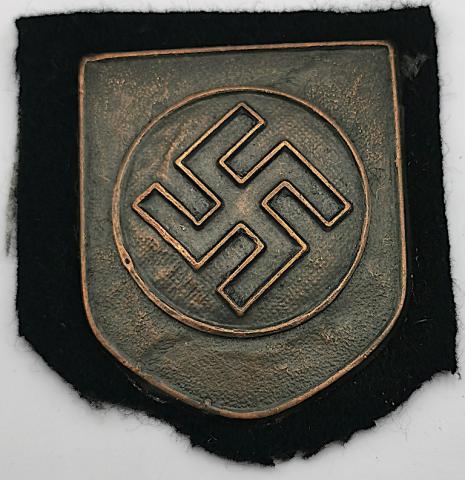
THIRD REICH SWASTIKA CAP INSIGNIA CUT FROM AFRIKA KORPS HELMET

THIRD REICH SWASTIKA CAP INSIGNIA AFRIKA KORPS HELMET IMA USA

THIRD REICH SWASTIKA CAP INSIGNIA CUT FROM AFRIKA KORPS HELMET

$69.00

Product

THIRD REICH SWASTIKA CAP INSIGNIA CUT FROM AFRIKA KORPS HELMET

I DON'T KNOW IF IT WAS CUT DIRECTLY FROM A CAP OF THE INSIGNIA WAS ADDED TO A FABRIK AFTERWARD.

The Afrika Korps or German Africa Corps (German: Deutsches Afrikakorps, DAK About this soundlisten (help·info)) was the German expeditionary force in Africa during the North African Campaign of World War II. First sent as a holding force to shore up the Italian defense of their African colonies, the formation fought on in Africa, under various appellations, from March 1941 until its surrender in May 1943. The unit's best known commander was Field Marshal Erwin Rommel.

Robert Satloff writes in his book Among the Righteous: Lost Stories from the Holocaust's Long Reach into Arab Lands that as the German and Italian forces retreated across Libya towards Tunisia, the Jewish population became victims upon which they released their anger and frustration. According to Satloff, Afrika Korps soldiers plundered Jewish property all along the Libyan coast. This violence and persecution only came to an end with the arrival of General Montgomery in Tripoli on January 23 1943.[8] German historian Clemens Vollnhals writes that the use of Jews by Afrika Korps as forced labour is barely known, but it did happen alongside persecution of Jewish population (although on smaller scale than in Europe) and some of the labourers were worked to death

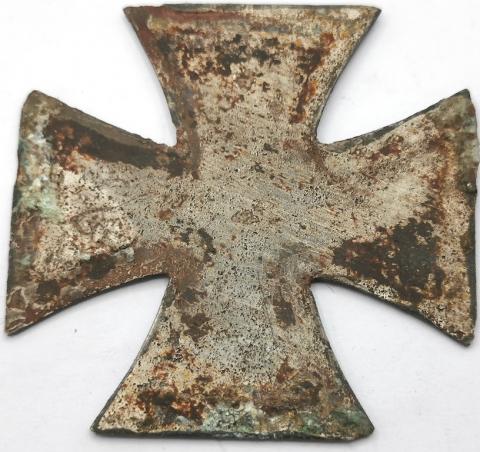
IRON CROSS 1ST CLASS MEDAL AWARD BACK PLATE RELIC FOUND WEHRMACHT WAFFEN SS

IRON CROSS 1ST CLASS MEDAL AWARD BACK PLATE RELIC FOUND WEHRMACHT WAFFEN SS

IRON CROSS 1ST CLASS MEDAL AWARD BACK PLATE RELIC FOUND WEHRMACHT WAFFEN SS

$25.00

Product

IRON CROSS 1ST CLASS MEDAL AWARD BACK PLATE WEHRMACHT WAFFEN SS

RELIC GROUND DUG FOUND

The Iron Cross (German: Eisernes Kreuz, abbreviated EK) was a military decoration in the Kingdom of Prussia, and later in the German Empire (1871–1918) and Nazi Germany (1933–1945). King Frederick William III of Prussia established it on 17 March 1813 during the Napoleonic Wars (EK 1813). The award was backdated to the birthday (10 March) of his late wife, Queen Louise. Louise was the first person to receive this decoration (posthumously). The recommissioned Iron Cross was also awarded during the Franco-Prussian War (EK 1870), World War I (EK 1914), and World War II (EK 1939). The Iron Cross awarded during World War II has a swastika in the center. The Iron Cross was usually a military decoration only, though there were instances awarded to civilians for performing military functions, such as Hanna Reitsch, who received the Iron Cross 2nd Class and Iron Cross 1st Class, and Melitta Schenk Gräfin von Stauffenberg, who received the Iron Cross, 2nd Class, civilian test pilots during World War II.

The cross symbol's design was black with a white or silver outline, was ultimately derived from the cross pattée of the Teutonic Order, used by knights on occasions from the 13th century.

The Prussian Army black crosses pattée was also used as the symbol of the succeeding German Army from 1871 to March–April 1918, when the Balkenkreuz replaced it. In 1956, it was re-introduced as the symbol of the Bundeswehr, the modern German armed forces (with the "ends" of the white border removed, as in the Balkenkreuz of 1918).

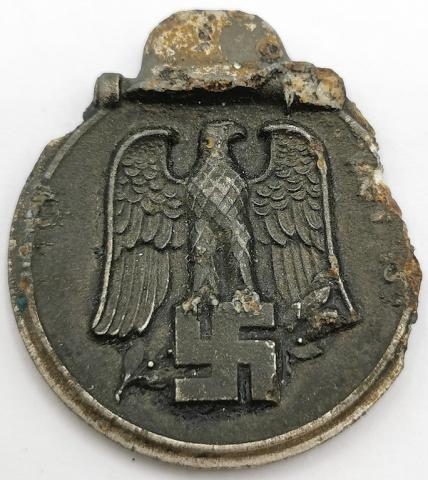
EASTERN FRONT OST MEDAL WINTERSCHLACHT AWARD SOVIET BATTLE RELIC BATTLEFIELD FOUND Ostmedaille

EASTERN FRONT OST MEDAL WINTERSCHLACHT AWARD SOVIET BATTLE RELIC BATTLEFIELD FOUND Ostmedaille

EASTERN FRONT OST MEDAL WINTERSCHLACHT AWARD SOVIET BATTLE RELIC BATTLEFIELD FOUND Ostmedaille

$50.00

Product

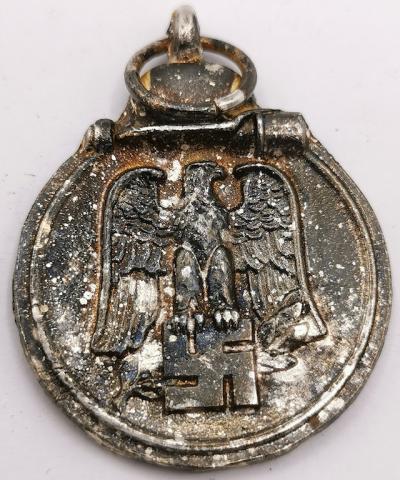
EASTERN FRONT OST MEDAL WINTERSCHLACHT AWARD SOVIET BATTLE RELIC BATTLEFIELD FOUND Ostmedaille

FOUND IN BATTLEFIELD IN RUSSIA

The Eastern Medal (German: Ostmedaille), officially the Winter Battle in the East 1941–42 Medal (German: Medaille Winterschlacht im Osten 1941/42), was a military award of the Wehrmacht which was created by ordinance of Adolf Hitler on 26 May 1942.[1]

The Eastern Medal was awarded to any member of the Wehrmacht and Waffen-SS "in recognition of experience in the struggle against the Bolshevik enemy and the Russian winter within the period from 15 November 1941 to 15 April 1942." It was also awarded posthumously to any service member who died in the line of duty within the Soviet Union.[2] It was wryly called the Frozen Meat Medal or the "Order of the Frozen Flesh" (German: Gefrierfleischorden).

EASTERN FRONT OST MEDAL WINTERSCHLACHT AWARD SOVIET BATTLE RELIC BATTLEFIELD FOUND Ostmedaille

EASTERN FRONT OST MEDAL WINTERSCHLACHT AWARD SOVIET BATTLE RELIC BATTLEFIELD FOUND Ostmedaille

EASTERN FRONT OST MEDAL WINTERSCHLACHT AWARD SOVIET BATTLE RELIC BATTLEFIELD FOUND Ostmedaille

$50.00

Product

EASTERN FRONT OST MEDAL WINTERSCHLACHT AWARD SOVIET BATTLE RELIC BATTLEFIELD FOUND Ostmedaille

FOUND IN BATTLEFIELD IN RUSSIA

The Eastern Medal (German: Ostmedaille), officially the Winter Battle in the East 1941–42 Medal (German: Medaille Winterschlacht im Osten 1941/42), was a military award of the Wehrmacht which was created by ordinance of Adolf Hitler on 26 May 1942.[1]

The Eastern Medal was awarded to any member of the Wehrmacht and Waffen-SS "in recognition of experience in the struggle against the Bolshevik enemy and the Russian winter within the period from 15 November 1941 to 15 April 1942." It was also awarded posthumously to any service member who died in the line of duty within the Soviet Union.[2] It was wryly called the Frozen Meat Medal or the "Order of the Frozen Flesh" (German: Gefrierfleischorden).

INFANTRY ASSAULT BADGE MEDAL AWARD IN SILVER MARKED WEHRMACHT WAFFEN SS

INFANTRY ASSAULT BADGE MEDAL AWARD IN SILVER MARKED WEHRMACHT WAFFEN SS MILITARIA DEALER

INFANTRY ASSAULT BADGE MEDAL AWARD IN SILVER MARKED WEHRMACHT WAFFEN SS

$75.00

Product

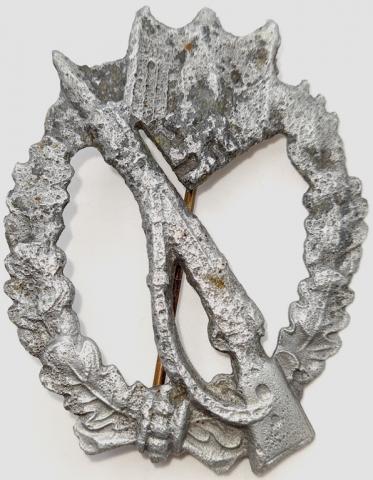
INFANTRY ASSAULT BADGE MEDAL AWARD IN SILVER MARKED WEHRMACHT WAFFEN SS

RELIC GROUND DUG FIND
MAKER MARKED WELL VISIBLE ON THE BACK

The Infantry Assault Badge (German: Infanterie-Sturmabzeichen) was a German war badge awarded to Waffen-SS and Wehrmacht Heer soldiers during the Second World War. This decoration was instituted on 20 December 1939 by the Commander-in-Chief of the German Army, Generalfeldmarschall Walther von Brauchitsch. It could be awarded to members of non-motorized Infantry units and units of the Gebirgsjäger that had participated in infantry assaults, with light infantry weapons, on at least three separate days of battle in the front line on or after 1 January 1940. When a counter offensive led to fighting, it could also apply. Award of the Infantry Assault Badge was authorized at regimental command level.

WW2 GERMAN NAZI USA VET SOUVENIR BATTELFIELD TUNIC REMOVED COLLAR TAB SET + SLEEVE PATCH FROM A COMMUNICATION OFFICER OF THE ARMORED FORCES

WW2 GERMAN NAZI USA VET SOUVENIR BATTELFIELD TUNIC REMOVED COLLAR TAB SET + SLEEVE PATCH FROM A COMMUNICATION OFFICER OF THE ARMORED FORCES

$150.00

Product

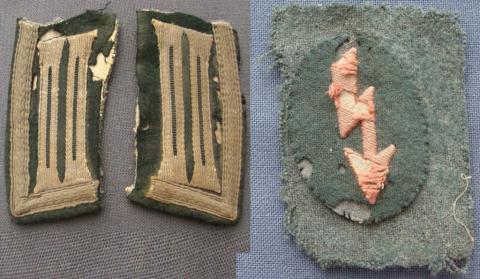
WW2 GERMAN NAZI USA VET SOUVENIR BATTELFIELD TUNIC REMOVED COLLAR TAB SET + SLEEVE PATCH FROM A COMMUNICATION OFFICER OF THE ARMORED FORCES

WOW NICE PIECE OF HISTORY !

1 COLLAR TAB SET
1 SLEEVE PATCH

REMOVED FROM THE SAME TUNIC DURING BATTLEFIELD, USA VET SOUVENIR!

Pages

Subscribe to RSS - Wehrmacht - Heer