Empty

Total: $0.00

WW2 GERMAN NAZI LUFTSCHUTZ GLADIATOR HELMET RLB LUFTWAFFE
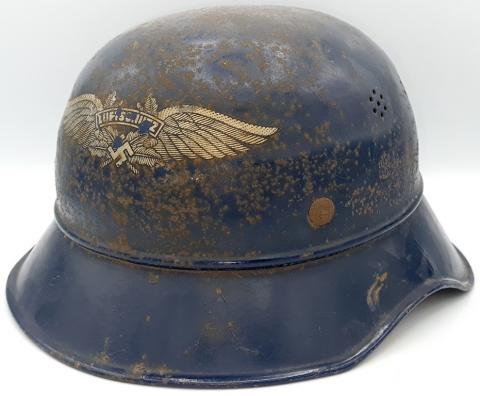
WW2 GERMAN NAZI LUFTSCHUTZ GLADIATOR HELMET RLB LUFTWAFFE

WW2 GERMAN NAZI LUFTSCHUTZ GLADIATOR HELMET RLB LUFTWAFFE

$335.00

Product

WW2 GERMAN NAZI LUFTSCHUTZ GLADIATOR HELMET RLB LUFTWAFFE

This is a fantastic example of an original WWII Luftschutz gladiator helmet.
These helmets were worn by air raid wardens and by teams tasked with extinguishing fires and rescuing survivors after air raids.
The exterior of the helmet retains about 80 percent of the original smooth, semi-gloss finish dark blue paint.

The “Luftschutz” winged swastika decal on the front is well preserved and 80 percent intact, with minor age toning.
The interior of this Luftschutz gladiator helmet is also in EXC+ellent condition.
The three pad, civil type liner shows only minor wear. The original, integral black leather friction buckle type chin strap is complete and intact. The outer rim of the helmet shows typical edge wear to the paint.

The rear inner skirt is stamped RL2-38/28 indicating manufacture by Paul Diener, in Dresden.
These helmets in this condition are getting much harder to find. This is a nice shelf example of the Luftschutz gladiator helmet.

Historical Description: German political and civil authorities began preparing for Allied air raids even before WWII started. The Reichs-Luftschutz-Bund (RLB), under the auspices of the German Luftwaffe, was the primary organization responsible for air raid protection and readiness. Shelters were constructed all over the German Reich, and civilians were issued gas masks. Members of the RLB wore many different kinds of uniforms and equipment, from fine regalia used in parades to work coveralls and protective equipment and gear for firefighting. After the outbreak of the war, the role of the Luftschutz was expanded, and other organizations were brought under the Luftschutz umbrella, including the Luftschutz-Warndienst, Luftschutzpolizei, and the Sicherheits- und Hilfsdienst. The men and women of the Luftschutz were tasked with extinguishing fires caused by incendiary bombs, often with nothing more than buckets of sand or water with hand pups. They maintained order in air raid bunkers and provided first aid to those injured in the bombings. In the day and night raids on the bombed-out cities, and even during the horrific firestorms that took the lives of thousands, the Luftschutz were on duty.THIS ITEM WILL BE SHIPPED FROM EUROPE (OUR SECONDARY STORAGE LOCATION).
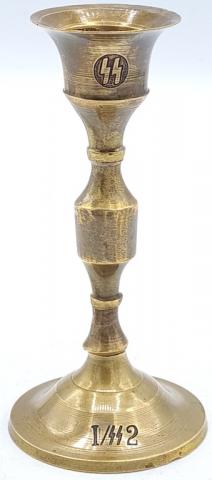
1st WAFFEN SS PANZER DIVISION LEIBSTANDARTE SS ADOLF HITLER LSSAH LAH MARKED CANDLESTICK

1st WAFFEN SS PANZER DIVISION LEIBSTANDARTE SS ADOLF HITLER LSSAH LAH FOR SALE MILITARIA

1st WAFFEN SS PANZER DIVISION LEIBSTANDARTE SS ADOLF HITLER LSSAH LAH MARKED CANDLESTICK

$295.00

Product

1st WAFFEN SS PANZER DIVISION LEIBSTANDARTE SS ADOLF HITLER LSSAH LAH MARKED CANDLESTICK

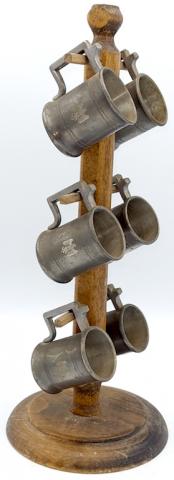
2ND REGIMENT, GOLDEN SILVERWARE CANDLESTICK
NICE PIECE !

The 1st SS Panzer Division "Leibstandarte SS Adolf Hitler", short LSSAH, (German: 1. SS-Panzerdivision "Leibstandarte SS Adolf Hitler")[2] began as Adolf Hitler's personal bodyguard, responsible for guarding the Führer's person, offices, and residences. Initially the size of a regiment, the LSSAH eventually grew into an elite division-sized unit during World War II.

The LSSAH participated in combat during the invasion of Poland, and was amalgamated into the Waffen-SS together with the SS-Verfügungstruppe (SS-VT) and the combat units of the SS-Totenkopfverbände (SS-TV) prior to Operation Barbarossa in 1941. By mid-1942 it had been increased in size from a regiment to a Panzergrenadier division and was designated SS Panzergrenadier Division "Leibstandarte SS Adolf Hitler". It received its final form as a Panzer division in October 1943.

Members of the LSSAH perpetrated numerous atrocities and war crimes, including the Malmedy massacre. They killed an estimated 5,000 prisoners of war in the period 1940–1945, mostly on the Eastern Front

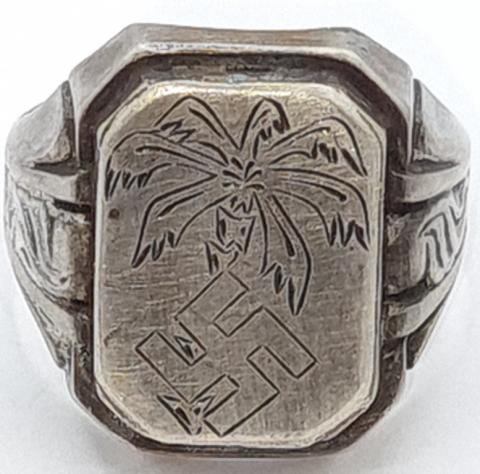
AFRIKA KORPS CAMPAIGN SILVER RING MARKED WITH THE OWNER'S ID + SWASTIKA WEHRMACHT WAFFEN SS

AFRIKA KORPS CAMPAIGN SILVER RING ID SWASTIKA WEHRMACHT WAFFEN SS

AFRIKA KORPS CAMPAIGN SILVER RING MARKED WITH THE OWNER'S ID + SWASTIKA WEHRMACHT WAFFEN SS

$245.00

Product

AFRIKA KORPS CAMPAIGN SILVER RING MARKED WITH THE OWNER'S ID + SWASTIKA WEHRMACHT WAFFEN SS

NICE AND UNIQUE HIGH QUALITY SILVER RING MARKS ON THE INSIDE WITH THE ID OF THE PREVIOUS OWNER - SOLDIER...

The North African campaign of the Second World War took place in North Africa from 10 June 1940 to 13 May 1943. It included campaigns fought in the Libyan and Egyptian deserts (Western Desert Campaign, also known as the Desert War) and in Morocco and Algeria (Operation Torch), as well as Tunisia (Tunisia Campaign).

The campaign was fought between the Allies, many of whom had colonial interests in Africa dating from the late 19th century, and the Axis Powers.[12][13] The Allied war effort was dominated by the British Commonwealth and exiles from German-occupied Europe. The United States officially entered the war in December 1941 and began direct military assistance in North Africa on 11 May 1942. Canada provided a small contingent of 201 commissioned officers and 147 non-commissioned officers.

Fighting in North Africa started with the Italian declaration of war on 10 June 1940. On 14 June, the British Army's 11th Hussars (assisted by elements of the 1st Royal Tank Regiment, 1st RTR) crossed the border from Egypt into Libya and captured the Italian Fort Capuzzo. This was followed by an Italian counter-offensive into Egypt and the capture of Sidi Barrani in September and its recapture by the British in December following a British Commonwealth counteroffensive, Operation Compass. During Operation Compass, the Italian 10th Army was destroyed and the German Afrika Korps—commanded by Erwin Rommel, who later became known as "The Desert Fox"—was dispatched to North Africa in February 1941 during Operation Sonnenblume to reinforce Italian forces in order to prevent a complete Axis defeat.

A fluctuating series of battles for control of Libya and regions of Egypt followed, reaching a climax in the Second Battle of El Alamein in October 1942 when British Commonwealth forces under the command of Lieutenant-General Bernard Montgomery inflicted a decisive defeat on Rommel's Afrika Korps and forced its remnants into Tunisia. After the Anglo-American landings (Operation Torch) in North-West Africa in November 1942, and subsequent battles against Vichy France forces (who then changed sides), the Allies encircled several hundred thousand German and Italian personnel in northern Tunisia and finally forced their surrender in May 1943.

Operation Torch in November 1942 was a compromise operation that met the British objective of securing victory in North Africa while allowing American armed forces the opportunity to engage in the fight against Nazi Germany on a limited scale. In addition, as Joseph Stalin, the leader of the Soviet Union, had long been pleading for a second front to be opened to engage the Wehrmacht and relieve pressure on the Red Army, it provided some degree of relief for the Red Army on the Eastern Front by diverting Axis forces to the North African theatre. Over half the German Ju 52 transport planes that were needed to supply the encircled Axis forces at Stalingrad were tied up supplying Axis forces in North Africa.

Information gleaned via British Ultra code-breaking intelligence proved critical to Allied success in North Africa. Victory for the Allies in this campaign immediately led to the Italian Campaign, which culminated in the downfall of the fascist government in Italy and the elimination of Germany's main European ally.

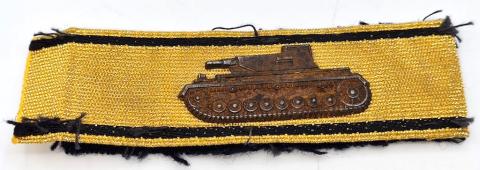
RARE WAFFEN SS WEHRMACHT PANZER TUNIC TANK BADGE IN GOLD AWARD

RARE WAFFEN SS WEHRMACHT PANZER TUNIC TANK BADGE IN GOLD AWARD

RARE WAFFEN SS WEHRMACHT PANZER TUNIC TANK BADGE IN GOLD AWARD

$345.00

Product

RARE WAFFEN SS WEHRMACHT PANZER TUNIC TANK BADGE IN GOLD AWARD

TANK PIN IS RUSTY SO PRICE IS CHEAPER.

The Tank Destruction Badge (German: Sonderabzeichen für das Niederkämpfen von Panzerkampfwagen durch Einzelkämpfer) was a World War II German military decoration awarded to individuals of the Wehrmacht who had single-handedly destroyed an enemy tank or an armored combat vehicle using a hand-held weapon.[1] Anti-tank units were ineligible for this award. It was established on 9 March 1942, but could be awarded for actions dating back to 22 June 1941 (the start of Operation Barbarossa, the German invasion of the Soviet Union). Prior to the introduction of this award, the soldier would be awarded the General Assault Badge for the action.[1]

On 18 December 1943, the OKH introduced a gold class that recognised the single-handed destruction of five tanks. A soldier could therefore have four silver badges which would all be replaced by a gold version upon the destruction of a fifth tank (to which separate silver could be added thereafter).

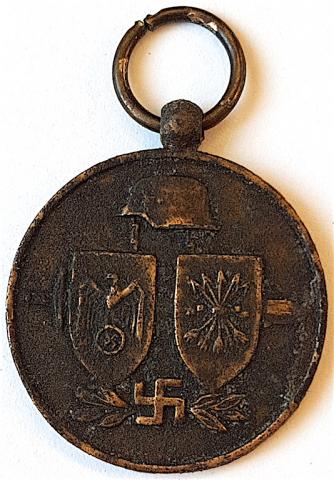
WW2 GERMAN NAZI RARE Commemorative Medal for Spanish Volunteers in the Struggle Against Bolshevism División Española de Voluntarios en Rusia

WW2 GERMAN NAZI RARE Commemorative Medal for Spanish Volunteers in the Struggle Against Bolshevism División Española de Voluntarios en Rusia

WW2 GERMAN NAZI RARE Commemorative Medal for Spanish Volunteers in the Struggle Against Bolshevism División Española de Voluntarios en Rusia

$95.00

Product

made by Deschler & Sohn in Munich
NO RIBBON
RELIC FOUND
EXTREMELY RARE

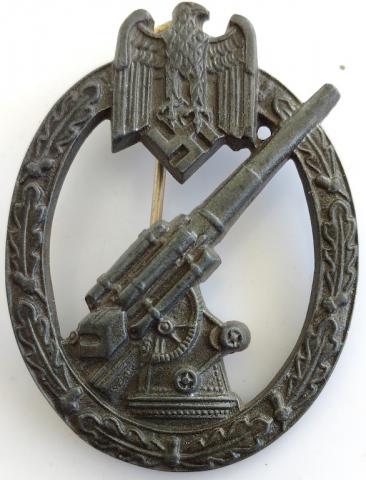
WW2 GERMAN NAZI ARMY WEHRMACHT OR WAFFEN SS FLAK BADGE AWARD MEDAL BY R.S

WW2 GERMAN NAZI ARMY WEHRMACHT OR WAFFEN SS FLAK BADGE AWARD MEDAL BY R.S

WW2 GERMAN NAZI ARMY WEHRMACHT OR WAFFEN SS FLAK BADGE AWARD MEDAL BY R.S

$179.99

Product

WW2 GERMAN NAZI ARMY WEHRMACHT OR WAFFEN SS FLAK BADGE AWARD MEDAL BY R.S

UNFORTUNATELY, THE HINGE IS DETACHED AND THE ATTACH IS MISSING.

YOU CAN FIND ON OTHER WEBSITE, THIS EXACT SAME BADGE FOR 750$USD !!!

I PRICED ACCORDINGLY TO IT'S CONDITION AND FOR FAST SALE CAUSE IT'S A VERY GREAT DEAL !!


Heeres-Flak Abzeichen by Rudolf Souval! The Heer flak badge was awarded for proven participation in several (16 points) successful actions against aerial targets. It is constructed out of a die struck zinc-alloy base that has been silvered washed and black burnished and lacquer finished. The oval shaped obverse depicts an anti-aircraft gun that is surrounded by a laurel leaf wreath and is below a Heer eagle, clutching a mobile swastika in its talons. The full back reverse shows a raised “R.S.” (Rudolf Souval, Wien) maker mark along with a soldered on steel sheet metal hinge (DETACHED) (with a raise mounting area), a soldered on round plate round wire variant catch and a round wire pin. (MISSING)

It measures approximately 2 3/8 inches tall by 1 ¾ inches wide. See pages 314-321 of M. Garlasco’s “The Flak Badges”. A nice one!

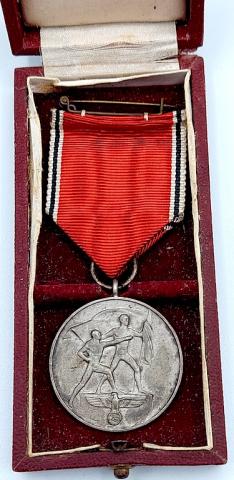
German 1938 Commemorative Sudetenland Medal award in nice case

German 1938 Commemorative Sudetenland Medal award in nice case

German 1938 Commemorative Sudetenland Medal award in nice case

$250.00

Product

German 1938 Commemorative Sudetenland Medal award in nice case

Instituted on 18 October 1938, the medal was awarded to participants in the occupations of Sudetenland in October 1938 and Czechoslovakia in March 1939.[2]

The medal was awarded to all German State officials and members of the German Wehrmacht and SS who entered the Sudetenland on 18 October 1938, and to Sudeten Nazis who had worked for union with Germany. Later a special bar for attachment to the ribbon was introduced for participation in the occupation of the remnants of Czechoslovakia on 15 March 1939, and to others who rendered valuable support. Last awarded on 31 December 1940, a total of 1,162,617 medals and 134,563 bars were bestowed.

The wearing of Nazi era awards was banned in 1945. The Sudetenland medal was not among those awards reauthorized for official wear by the Federal Republic of Germany in 1957.

Design
The medal was circular and similar in appearance as the Anschluss Medal, the reverse only differed in the date. It was designed by Professor Richard Klein. On the obverse a man holding the Nazi flag stands on a podium bearing the eagle emblem of the Third Reich. He assists a second man onto the podium, whose right arm bears a broken shackle. This symbolizes the joining of the area to the Reich. On the reverse is the inscription date "1. Oktober 1938" (1 October 1938). The date is surrounded with the words "Ein Volk, Ein Reich, Ein Führer" (One People, One Nation, One Leader).

The medal was die-struck and high in detail, with a bronze finish. It was suspended from a striped black, red, black ribbon and white outer stripes, the colors of the Sudetenland.

Pages

Subscribe to RSS - Wehrmacht - Heer