Empty

Total: $0.00

SCHO-KA-KOLA TIN CAN WITH THE THIRD REICH EAGLE - PERVITIN CRYSTAL METH DRUGS
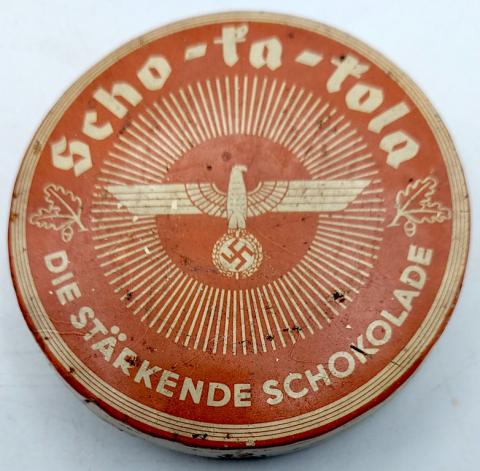
SCHO-KA-KOLA TIN CAN THIRD REICH EAGLE PERVITIN CRYSTAL METH DRUGS

SCHO-KA-KOLA TIN CAN WITH THE THIRD REICH EAGLE - PERVITIN CRYSTAL METH DRUGS

$365.00

Product

SCHO-KA-KOLA TIN CAN WITH THE THIRD REICH EAGLE - PERVITIN CRYSTAL METH DRUGS

THE BEST OF THEM ALL, THE ONE WITH THE REICH EAGLE.
AMAZING CONDITION, FROM THE WELHELM FELSCHE FABRIK

EXTREMELY RARE TO FIND, AMAZING PIECE OF HISTORY !
NO ONE HAVE ONE FOR SALE, THIS IS YOUR CHANCE !

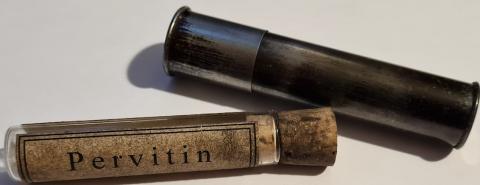
Scho-ka-kola is a chocolate spiced with caffeine, pervitin and methamphetamine. It was commonly used by the Wehrmacht and SS and was also known as pilot chocolate or something since pilots would eat this to stay hydrated woke and energized.

In World War II, Scho-Ka-Kola was colloquially known as the "Aviator Chocolate" (German Fliegerschokolade), as it was commonly provided with Luftwaffe pilot and crew rations, to induce or extend wakefulness and alertness, especially on night-bombing missions, and was also issued to flight-crews in blue canisters as emergency sea-survival rations (German Seenotpackung).

Original retail canister in 1941, scho-ka-kola printed in lowercase Fraktur calligraphy.
Scho-Ka-Kola was also issued during World War II to German tank crews, as well as German U-boat crews and the German Army. During the occupation period it was also distributed to the German population by the Allies. German Wehrmacht-issue Scho-Ka-Kola were designated 'Wehrmacht Packung' on the container underside, issued in either the metal tin or cardboard container version.

Scho-Ka-Kola is mentioned three times in Johann Voss's World War II autobiography, Black Edelweiss. "Johann Voss", real name unknown, joins the Waffen-SS in 1943 at only 17. He ends up in Northern Finland as an SS mountain ranger, and participates in heavy fighting against the Russians. When things go particularly bad, round tin boxes of Scho-Ka-Kola are issued to the troops. He also claims that during the Battle of the Bulge (particularly, the town of Reipertsweiler, in which Voss participated in a German victory), Scho-Ka-Kola was given to captured American troops as an act of respect for their bravery. Voss details Scho-Ka-Kola in the footnotes, calling the chocolate "pure luxury" and explains that each round tin contains two discs of dark chocolate, laced with caffeine from coffee beans.
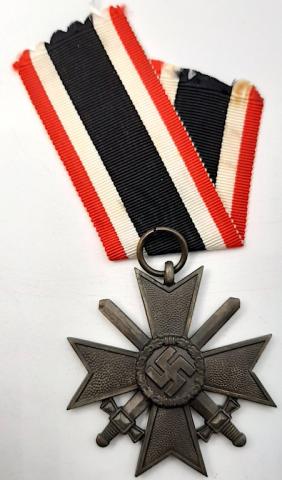
WW2 GERMAN NAZI MERIT CROSS WITH SWORDS MEDAL AWARD

WW2 GERMAN NAZI MERIT CROSS WITH SWORDS MEDAL AWARD

WW2 GERMAN NAZI MERIT CROSS WITH SWORDS MEDAL AWARD

$75.00

Product

WW2 GERMAN NAZI MERIT CROSS WITH SWORDS MEDAL AWARD

The War Merit Cross (German: Kriegsverdienstkreuz) was a state decoration of Nazi Germany during World War II. By the end of the conflict it was issued in four degrees and had an equivalent civil award. A "de-Nazified" version of the War Merit Cross was reissued in 1957 by the Bundeswehr for its veterans.

This award was created by Adolf Hitler in October 1939 as a successor to the non-combatant Iron Cross which was used in earlier wars (similar medal but with a different ribbon). The award was graded in the same manner as the Iron Cross: War Merit Cross Second Class, War Merit Cross First Class, and Knights Cross of the War Merit Cross. The award had two variants: with swords given to soldiers for exceptional service "not in direct connection with combat", and without swords given to civilians for meritorious service in "furtherance of the war effort". Recipients had to have the lower grade of the award before getting the next level.

The wearing of Nazi era decorations was banned in Germany after the war, as was any display of the swastika. Veterans awarded the War Merit Cross were therefore unable to wear it, either in uniform or – publicly – on civilian dress. In 1957 the Federal Republic of Germany authorised alternative 'de-nazified' replacement versions of World War II period war decorations. These could be worn both on Bundeswehr uniform and in civilian dress. The new version of the War Merit Cross replaced the swastika on the obverse central disc of the cross with the date "1939" (as on the reverse disc of the original version), the reverse disc being blank. The wearing of Nazi era decorations in any form continued to be banned in the German Democratic Republic until German reunification in 1990.

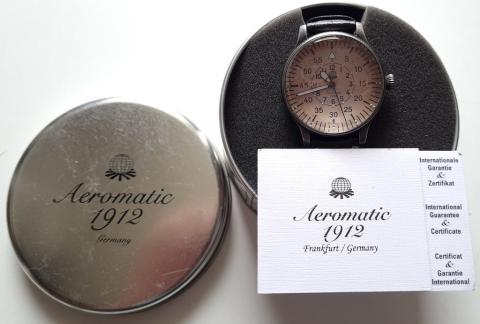
WW2 1940 AVIATION LUFTWAFFE WATCH IN ORIGINAL CASE AND PAPERS LIMITED EDITION EXACT REPLICA BY AEROMATIC 1912

WW2 1940 AVIATION LUFTWAFFE WATCH ORIGINAL CASE PAPERS AEROMATIC 1912

WW2 1940 AVIATION LUFTWAFFE WATCH IN ORIGINAL CASE AND PAPERS LIMITED EDITION EXACT REPLICA BY AEROMATIC 1912

$175.00

Product

WW2 1940 AVIATION LUFTWAFFE WATCH IN ORIGINAL CASE AND PAPERS LIMITED EDITION EXACT REPLICA BY AEROMATIC 1912

AMAZING DESIGN !
A replica of an aviation watch made by the German company Aeromatic1912 - not available for purchase in official distribution. The watch is functional, it works.
Model: A1355

A replica of an aviation observation watch, made by the German company Aeromatic 1912

A watch from the Deutsche Flieger Legende series. Observation watches were used by Luftwaffe soldiers (German airmen) during World War II. In 1940, the Minister of Aviation of the Third Reich ordered the production of watches with particularly high parameters for the army, designated as 'FL 23883'.

Pages

Subscribe to RSS - Luftwaffe