WW2 German Nazi Waffen SS D.R.G.M gorget
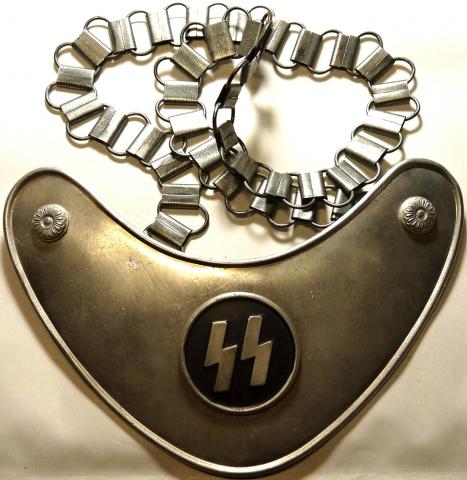
WW2 German Nazi Waffen SS D.R.G.M gorget
$379.00
Product
WW2 German Nazi Waffen SS D.R.G.M gorget
i think that the back tissus was replaced and not an original
Empty
WW2 German Nazi Waffen SS D.R.G.M gorget
i think that the back tissus was replaced and not an original
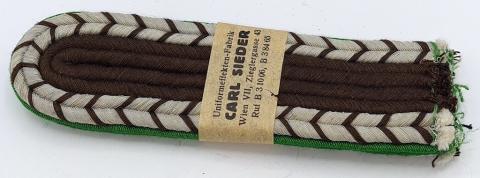
GESTAPO BERLIN POLIZEI POLICE SEALED UNISSUED SHOULDER BOARD SET TUNIC UNIFORM
WITH THE ORIGINAL MAKER TAG WHICH SEALS THE SET.
ALMOST IMPOSSIBLE TO FIND MINT LIKE THAT !
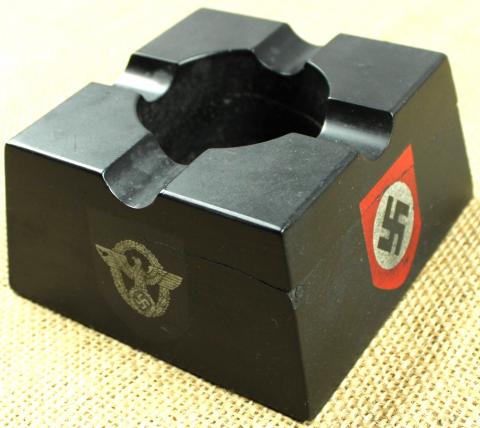
WW2 German Nazi Gestapo police polizei ashtray 4 sides decals swatika marked
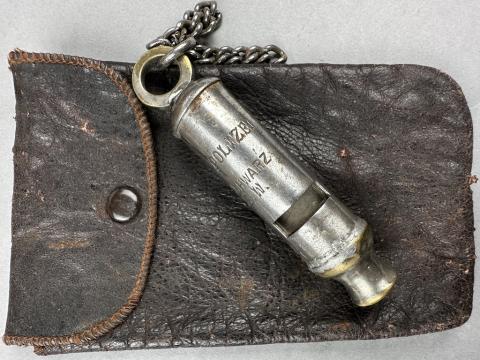
AMAZING WAFFEN SS Gestapo Polizei Police whistle in etui named Deutsch Berlin with iron cross
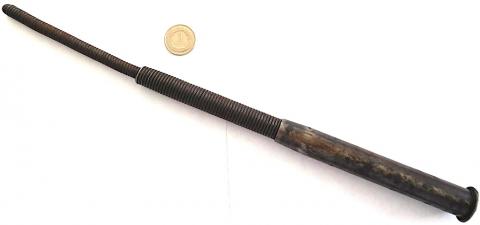
Himmler Security Police SIPO polizei gestapo metal truncheon whip Sicherheitspolizei
Very nice SIPO retractible truncheon.
Steel wire construction which extends from a 6 1/4\" metal tube.
for German SIPO Polizei. In very good condition.
These were used by Sicherheitspolizei during Nazi Germany. RARE
When the Nazis came to national power, Germany, as a federal state, had myriad local and centralized police agencies, which often were un-coordinated and had overlapping jurisdictions. Himmler and Heydrich's grand plan was to fully absorb all the police and security apparatus into the Schutzstaffel. To this end, Himmler took command first of the Gestapo (itself developed from the Prussian Secret Police). Then on 17 June 1936 all police forces throughout Germany were united, following Adolf Hitler's appointment of Himmler as Chef der Deutschen Polizei (Chief of German Police). As such he was nominally subordinate to Interior Minister Wilhelm Frick, but in practice Himmler answered only to Hitler.
Himmler immediately reorganised the police, with the state agencies statutorily divided into two groups: the Ordnungspolizei (Order Police; Orpo), consisting of both the national uniformed police and the municipal police, and the Sicherheitspolizei (Security Police; SiPo)rm, consisting of the Kripo and Gestapo. Reinhard Heydrich was appointed chief of the SiPo and was already head of the party Sicherheitsdienst (Security Service; SD) and the Gestapo. The two police branches were commonly known as the Orpo and SiPo (Kripo and Gestapo combined), respectively.
The idea was to fully identify and integrate the party agency (SD) with the state agency (SiPo). Most of the SiPo members were encouraged or volunteered to become members of the SS and many held a rank in both organisations. Nevertheless, in practice there was jurisdictional overlap and operational conflict between the SD and Gestapo. The Kripo kept a level of independence since its structure was longer-established. Himmler founded the Hauptamt Sicherheitspolizei in order to create a centralized main office under Heydrich's overall command of the SiPo.
The Einsatzgruppen were formed under the direction of Heydrich and operated by the SS under the SiPo and SD. The Einsatzgruppen had its origins in the ad hoc Einsatzkommando formed by Heydrich to secure government buildings and documents following the Anschluss in Austria in March 1938. Originally part of the SiPo, two units of Einsatzgruppen were stationed in the Sudetenland in October 1938. When military action turned out not to be necessary because of the Munich Agreement, the Einsatzgruppen were assigned to confiscate government papers and police documents. They also secured government buildings, questioned senior civil servants, and arrested as many as 10,000 Czech communists and German citizens.
SHIP TO CANADA ONLY.
if you want it shipped to the USA, you must get the authorisation papers from the USA customs first.
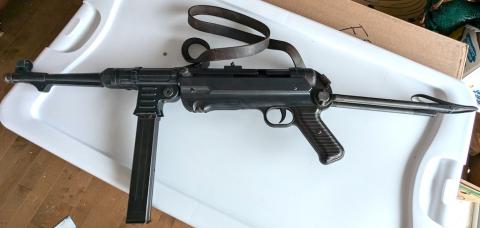
The MP 40 (Maschinenpistole 40) is a submachine gun chambered for the 9×19mm Parabellum cartridge. Developed in Nazi Germany, it saw extensive service in the Axis forces during World War II.
Designed in 1938 by Heinrich Vollmer with inspiration from its predecessor the MP 38, it was heavily used by infantrymen (particularly by platoon- and squad-leaders), and by paratroopers, on the Eastern and Western Fronts as well as by the crews of armoured fighting vehicles.[7][8] Its advanced and modern features made it a favorite among soldiers and popular in countries from various parts of the world after the war.
The Allies often referred to the MP 40 as the "Schmeisser", after the firearms-designer Hugo Schmeisser (1884-1953). In 1917 Schmeisser had designed the MP 18, which was the first mass-produced submachine gun. He did not, however, have anything to do with the design or development of the MP 40, although he held a patent on the magazine.[9]
The MP 40's variants included the MP 40/I and the MP 41. Erma Werke produced an estimated 1.1 million MP 40s between 1940 and 1945.
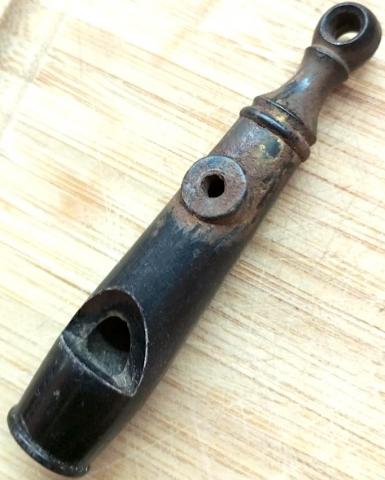
WW2 German Nazi Waffen SS Gestapo Police Polizei Berlin staatpolizei SA early whistle
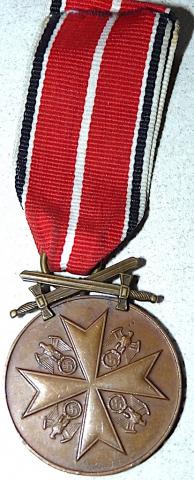
WW2 German Nazi SCARCE German Eagle Order Medal award with Swords Deutsche Verdienst
ribbon is NOT original, it's a replacement.
that's why price is CHEAP
RARE
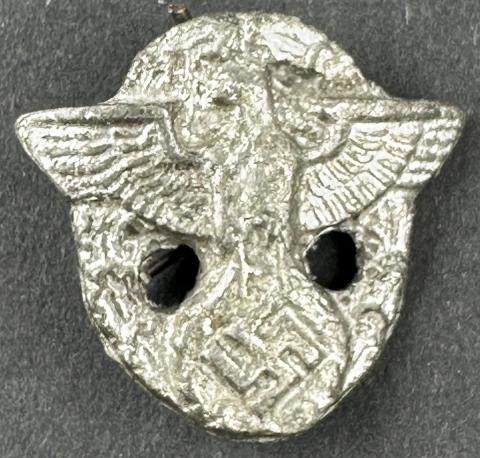
WW2 german Nazi Gestapo Straat police berlin tunic tiny pin
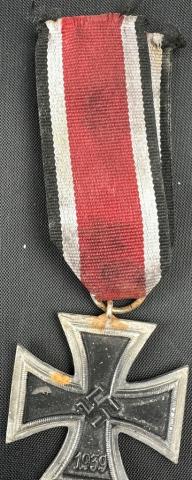
WW2 German Nazi IRON CROSS 2nd classe medal award Waffen SS Wehrmacht
