WW2 German Nazi Waffen SS Totenkopf zippo lighter relic field gear panzer
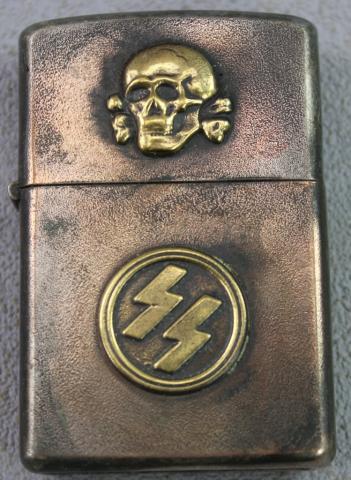
WW2 German Nazi Waffen SS Totenkopf zippo lighter relic field gear panzer
$289.00
Product
WW2 German Nazi Waffen SS Totenkopf zippo lighter relic field gear panzer
Empty
WW2 German Nazi Waffen SS Totenkopf zippo lighter relic field gear panzer
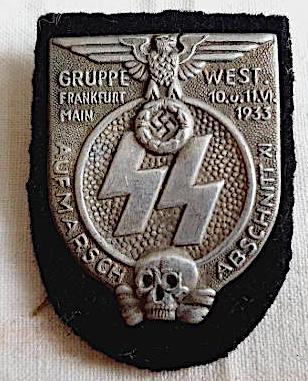
Waffen SS Totenkopf early panzer division gruppe west frankfurt 1935 shield badge
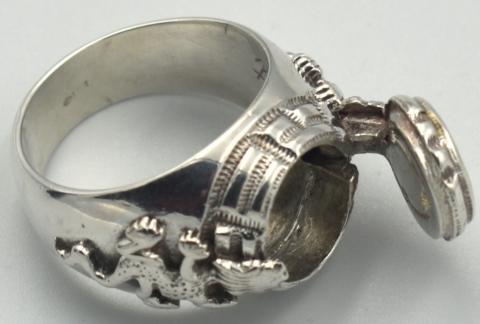
WW2 GERMAN NAZI EXTREMELY RARE GENERAL HIMMLER SUICIDE POISON SILVER RING
A RUBY EYE WITH A GOLD PLATED SILVER IS DECORATIVE.
TWO LIZARDS on the sides.
marks inside the THE RING.
same as Himmler used and many other generals and officers at the end of the war.
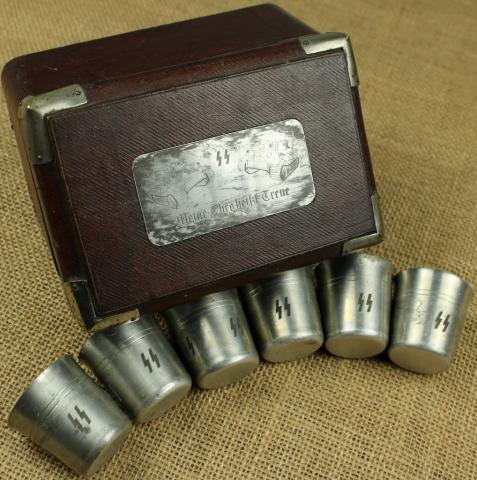
WW2 German Nazi WAFFEN SS PANZER GRENADIER division set of silverware SS cups in case with commemorative plate
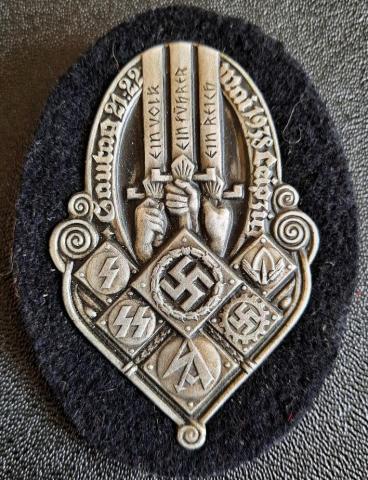
WW2 GERMAN NAZI WAFFEN SS SA MAI 1938 LEIPZIG BADGE SHIELD
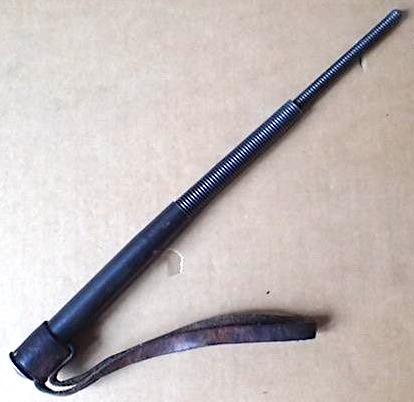
Himmler Security Police SIPO polizei gestapo WEST GERMANY metal truncheon whip Sicherheitspolizei
Very nice SIPO retractible truncheon.
Steel wire construction which extends from a 6 1/4\" metal tube.
for German SIPO Polizei. In very good condition.
These were used by Sicherheitspolizei during Nazi Germany. RARE
When the Nazis came to national power, Germany, as a federal state, had myriad local and centralized police agencies, which often were un-coordinated and had overlapping jurisdictions. Himmler and Heydrich's grand plan was to fully absorb all the police and security apparatus into the Schutzstaffel. To this end, Himmler took command first of the Gestapo (itself developed from the Prussian Secret Police). Then on 17 June 1936 all police forces throughout Germany were united, following Adolf Hitler's appointment of Himmler as Chef der Deutschen Polizei (Chief of German Police). As such he was nominally subordinate to Interior Minister Wilhelm Frick, but in practice Himmler answered only to Hitler.
Himmler immediately reorganised the police, with the state agencies statutorily divided into two groups: the Ordnungspolizei (Order Police; Orpo), consisting of both the national uniformed police and the municipal police, and the Sicherheitspolizei (Security Police; SiPo)rm, consisting of the Kripo and Gestapo. Reinhard Heydrich was appointed chief of the SiPo and was already head of the party Sicherheitsdienst (Security Service; SD) and the Gestapo. The two police branches were commonly known as the Orpo and SiPo (Kripo and Gestapo combined), respectively.
The idea was to fully identify and integrate the party agency (SD) with the state agency (SiPo). Most of the SiPo members were encouraged or volunteered to become members of the SS and many held a rank in both organisations. Nevertheless, in practice there was jurisdictional overlap and operational conflict between the SD and Gestapo. The Kripo kept a level of independence since its structure was longer-established. Himmler founded the Hauptamt Sicherheitspolizei in order to create a centralized main office under Heydrich's overall command of the SiPo.
The Einsatzgruppen were formed under the direction of Heydrich and operated by the SS under the SiPo and SD. The Einsatzgruppen had its origins in the ad hoc Einsatzkommando formed by Heydrich to secure government buildings and documents following the Anschluss in Austria in March 1938. Originally part of the SiPo, two units of Einsatzgruppen were stationed in the Sudetenland in October 1938. When military action turned out not to be necessary because of the Munich Agreement, the Einsatzgruppen were assigned to confiscate government papers and police documents. They also secured government buildings, questioned senior civil servants, and arrested as many as 10,000 Czech communists and German citizens.
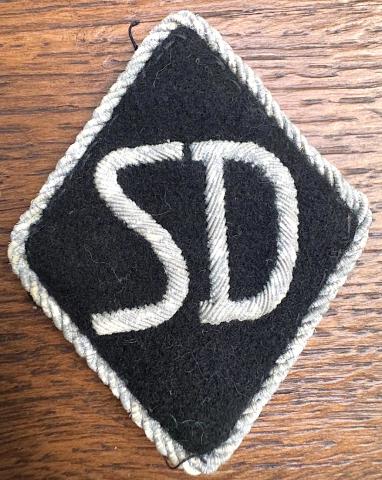
WW2 German Nazi Reinhard Heydrich SECURITY POLICE SD diamond tab sleeve patch cloth officer Sicherheitsdienst
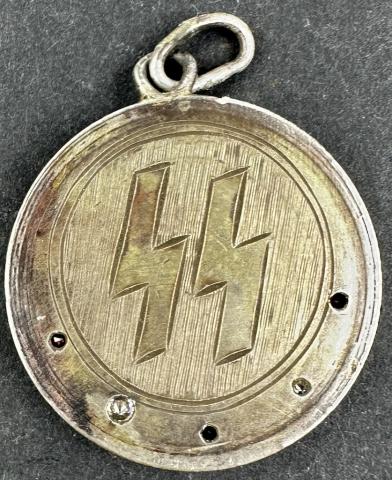
WW2 German Nazi WAFFEN SS commemorative medaillon pendant with third reich EAGLE and swastika

huge set of WAFFEN SS Lazarett scholl RECORDS with 3 SS books in case
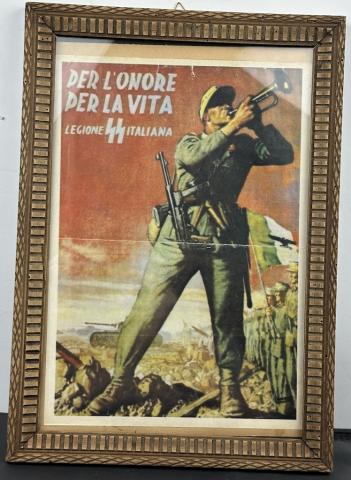
SCARCE Waffen SS Legion italian italy volonteers recruitment poster in frame
