Empty

Total: $0.00

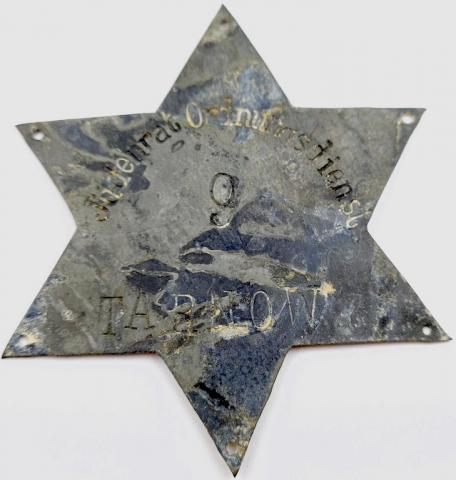
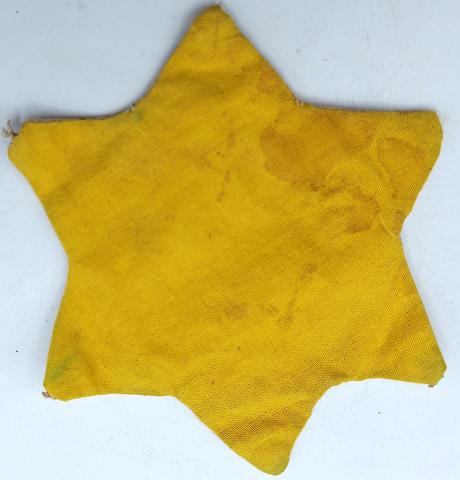
Worn blank larger Star of David from Poland Jew Jewish patch holocaust Getto Ghetto VERY RARE VARIATION

Worn blank larger Star of David from Poland Jew Jewish patch holocaust Getto Ghetto VERY RARE VARIATION

Worn blank larger Star of David from Poland Jew Jewish patch holocaust Getto Ghetto VERY RARE VARIATION

$1,195.00

Product

Worn blank larger Star of David from Poland Jew Jewish patch holocaust Getto Ghetto

this is VERY RARE VARIATION
it's a larger star, the biggest one.
see last photos to compare with a JUDE one and also a photo of the WW2 period showing a Jew wearing similar stars...

see also 2nd ant 3nd photo that shows way more common star's variation getting sold over 3000$ with the buyers fees, on auctions, last month...
these are getting VERY difficult to find, this blank variation, it's the second one i see in 10 years !!!

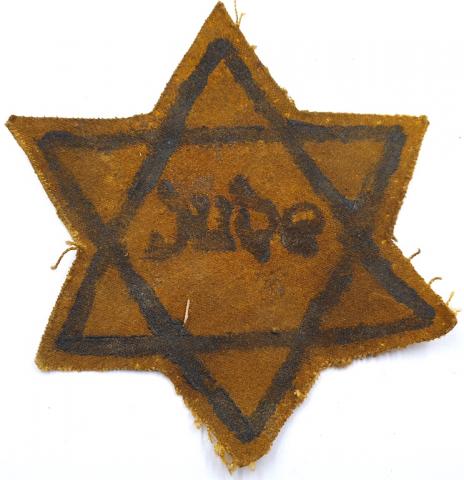
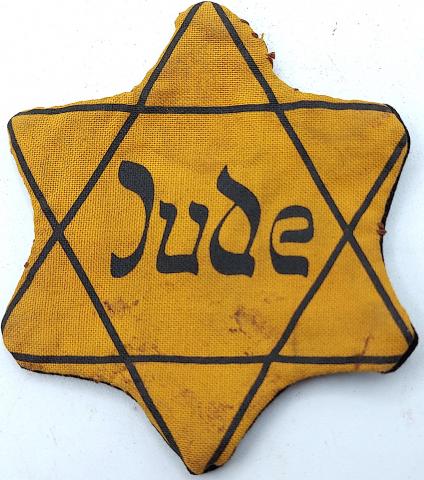
nice WORN Star of David from Germany JUDE with back fabrik Jew Jewish original holocaust patch Ghetto Getto

nice WORN Star of David from Germany JUDE with back fabrik Jew Jewish original holocaust patch Ghetto Getto

nice WORN Star of David from Germany JUDE with back fabrik Jew Jewish original holocaust patch Ghetto Getto

$1,495.00

Product

nice WORN Star of David from Germany JUDE with back fabrik Jew Jewish original holocaust patch Ghetto Getto

see 2nd and third photo. it's 2 worn JUDE star that ended over 3500$ after the buyer's fees on auctions, a couple of days ago

these are investment, they increase like 100% every year.

jump on this opportunity to get one for cheaper...

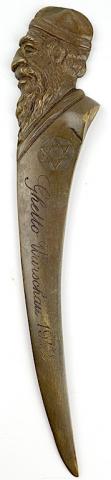
Holocaust personnal Rabbi belongings souvenir from Ghetto Warschau, 1942 - letter opener with Star of David, engraved

Holocaust personnal Rabbi belongings souvenir getto Ghetto Warschau 1942 letter Star of David original for sale

Holocaust personnal Rabbi belongings souvenir from Ghetto Warschau, 1942 - letter opener with Star of David, engraved

$225.00

Product

Holocaust personnal Rabbi belongings souvenir from Ghetto Warschau, 1942 - letter opener with Star of David, engraved

purchased from the relative. was owned by a Rabbi who survived Ghetto Warschau during the war.

nice engraves on it, star of David....

unique piece of Holocaust history !

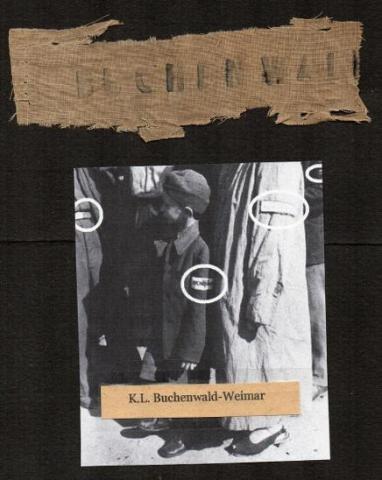
Concentration camp Buchenwald inmate sleeve liberation patch + a photo showing similar patch

Concentration camp Buchenwald inmate sleeve liberation patch photo uniform original inmate artifact

Concentration camp Buchenwald inmate sleeve liberation patch + a photo showing similar patch

$245.00

Product

Concentration camp Buchenwald inmate sleeve liberation patch + a photo showing similar patch

very rare Buchenwald liberation patch.
it comes with a photo showing a similar patch on an inmate

nice set !

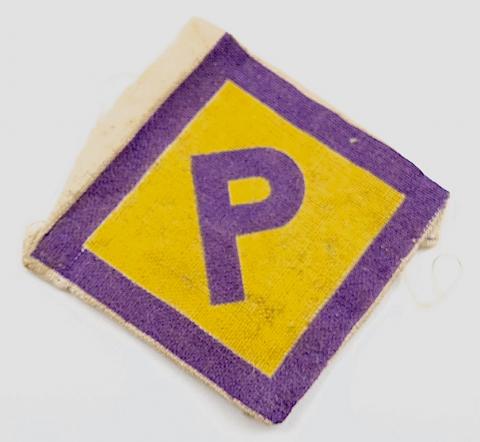
Holocaust Poland Polish workers Forced Labour "P" Patch Zivilarbeiter

Holocaust Poland Polish workers Forced Labour "P" Patch Zivilarbeiter

Holocaust Poland Polish workers Forced Labour "P" Patch Zivilarbeiter

$89.00

Product

Holocaust Poland Polish workers Forced Labour "P" Patch Zivilarbeiter

The "P" symbol[1] or "P" badge was introduced on 8 March 1940 by the Nazi Germany General Government with relation to the requirement that Polish workers (Zivilarbeiter) used during World War II as forced laborers in Germany (following the German invasion and occupation of Poland in 1939) display a visible symbol marking their ethnic origin. The symbol was introduced with the intent to be used as a cloth patch, which indeed was the most common form, but also reproduced on documents (through stamps) and posters. The badge was intended to be humiliating, and like the similar Jewish symbol, can be seen as a badge of shame.

Design and usage
The design was introduced in the Polish decrees (laws concerning Polish workers in Germany) of 8 March 1940. The symbol was a diamond with sides of five centimeters. The border (about half a centimetre wide) and the letter P (two and a half centimetres tall) were violet, while the inside of the symbol was yellow. The letter "P" badge was to be worn on the right breast of every garment worn. Those who did not obey the rules were subject to a fine of up to 150 Reichsmarks and arrested with a possible penalty of six weeks' detention.

The choice of color and shape might have been chosen to avoid any association with national symbols of Poland. It was the first official, public badge-like mark intended for identification of individuals based on their racial or ethnic origin (or other social characteristics) introduced in Nazi Germany, preceding the better-known "Jewish yellow star" badge introduced a year later, in September 1941.

In January 1945 the Central Office for Reich Security proposed a new design for a Polish badge, a yellow ear of corn on a red and white label, but it was never implemented.

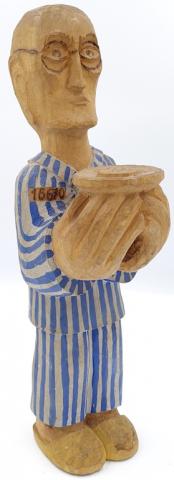
Concentration Camp AUSCHWITZ Kolbe wooden statue made by a survivor with uniform and patches UNIQUE PIECE OF HOLOCAUST HISTORY !

Concentration Camp AUSCHWITZ Kolbe wooden statue made by a survivor with uniform and patches UNIQUE PIECE OF HOLOCAUST HISTORY !

Concentration Camp AUSCHWITZ Kolbe wooden statue made by a survivor with uniform and patches UNIQUE PIECE OF HOLOCAUST HISTORY !

$435.00

Product

Concentration Camp AUSCHWITZ Kolbe wooden statue made by a survivor with uniform and patches

what an AMAZING AND UNIQUE PIECE OF HOLOCAUST HISTORY !

Maximilian Maria Kolbe (born Raymund Kolbe; Polish: Maksymilian Maria Kolbe [maksɨˌmʲilʲan ˌmarʲja ˈkɔlbɛ]; 8 January 1894 – 14 August 1941), venerated as Saint Maximilian Kolbe, was a Polish Catholic priest and Conventual Franciscan friar who volunteered to die in place of a man named Franciszek Gajowniczek in the German death camp of Auschwitz, located in German-occupied Poland during World War II. He had been active in promoting the veneration of the Immaculate Virgin Mary, founding and supervising the monastery of Niepokalanów near Warsaw, operating an amateur-radio station (SP3RN), and founding or running several other organizations and publications.

On 10 October 1982, Pope John Paul II canonized Kolbe and declared him a martyr of charity. The Catholic Church venerates him as the patron saint of amateur radio operators, drug addicts, political prisoners, families, journalists, and prisoners. John Paul II declared him "The Patron Saint of Our Difficult Century." His feast day is 14 August, the day of his death.

Due to Kolbe's efforts to promote consecration and entrustment to Mary, he is known as the Apostle of Consecration to Mary.

On 17 February 1941, the monastery was shut down by the German authorities.[2] That day Kolbe and four others were arrested by the Gestapo and imprisoned in the Pawiak prison.[2] On 28 May, he was transferred to Auschwitz as prisoner 16670.[24]

Maximilian Kolbe, on a West German postage stamp, marked Auschwitz
Continuing to act as a priest, Kolbe was subjected to violent harassment, including beatings and lashings. Once he was smuggled to a prison hospital by friendly inmates. At the end of July 1941, one prisoner escaped from the camp, prompting SS-Hauptsturmführer Karl Fritzsch, the deputy camp commander, to pick ten men to be starved to death in an underground bunker to deter further escape attempts. When one of the selected men, Franciszek Gajowniczek, cried out, "My wife! My children!" Kolbe volunteered to take his place.

According to an eyewitness, who was an assistant janitor at that time, in his prison cell Kolbe led the prisoners in prayer. Each time the guards checked on him, he was standing or kneeling in the middle of the cell and looking calmly at those who entered. After they had been starved and deprived of water for two weeks, only Kolbe remained alive.

Death
The guards wanted the bunker emptied, so they gave Kolbe a lethal injection of carbolic acid. Kolbe is said to have raised his left arm and calmly waited for the deadly injection. He died on 14 August 1941. His remains were cremated on 15 August, the feast day of the Assumption of Mary.
Pages

Subscribe to RSS - Teaching holocaust artifacts