Empty

Total: $0.00

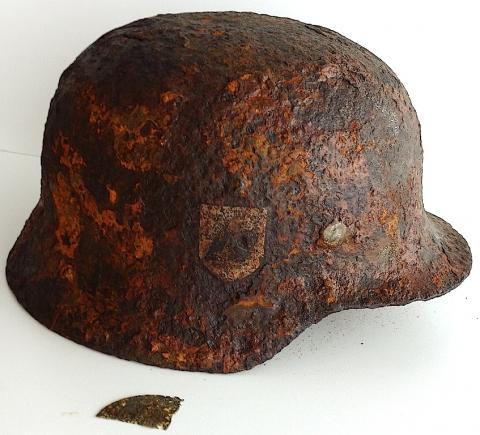
WW2 GERMAN WAFFEN SS TOTENKOPF PANZER GRENADIER EAST FRONT BATTLE RELIC FOUND M42 SINGLE DECAL SS HELMET + DOG TAG SS ID

WW2 GERMAN WAFFEN SS TOTENKOPF PANZER GRENADIER EAST FRONT BATTLE RELIC FOUND M42 SINGLE DECAL SS HELMET WITH DOG TAG

WW2 GERMAN WAFFEN SS TOTENKOPF PANZER GRENADIER EAST FRONT BATTLE RELIC FOUND M42 SINGLE DECAL SS HELMET + DOG TAG SS ID

$895.00

Product

M42 SINGLE DECAL SS TOTENKOPF HELMET

RELIC FOUND IN RUSSIA - EAST FRON SOVIET BATTLE RELIC.

FOUND WITH 1/4 OF THE DOG TAG - WE SEE ON IT A TOTENKOPF SS PANZER DIVISION

WHICH IS THE MOST FAMOUS SS DIVISION - EVERYTHING FROM THIS DIVISION WORTH LOT OF $$$$$

SS DECAL IS STILL PRETTY WELL VISIBLE AND REMAIN COMPLETE.

AMAZING PIECE - HIGHLY HISTORICAL !!! - VERY AFFORDABLE PRICE FOR A SS HELMET 100000% ORIGINAL THAT ACTUALLY MADE WAR!!!

NO STAMPS REMAIN VISIBILE ON THE INSIDE.

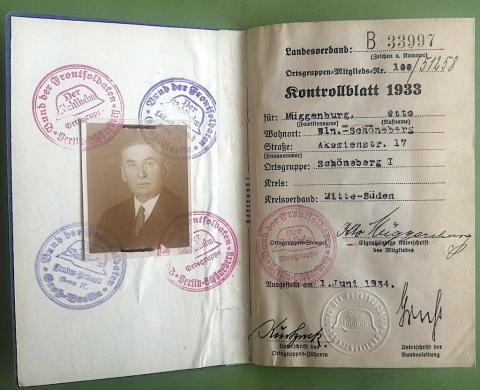
NSDAP early booklet ID with photo and stamps - ww1 veteran from n.s Deutscher frontkampfer-bund stahlhem

NSDAP ID ausweis photo n.s Deutscher frontkampferbund stahlhem

NSDAP early booklet ID with photo and stamps - ww1 veteran from n.s Deutscher frontkampfer-bund stahlhem

$89.00

Product

NSDAP early booklet ID with photo and stamps - ww1 veteran from n.s Deutscher frontkampfer-bund stahlhem

The Stahlhelm, League of Front Soldiers, was a military association during the Weimar Republic . It was founded shortly after the end of the First World War on December 25, 1918, by reserve officer Franz Seldte in Magdeburg . Seldte co-chaired the association with Theodor Duesterberg . The association was considered closely aligned with the anti-democratic German National People's Party (DNVP), and the Stahlhelm often provided (armed) security at its party meetings .

From 1933 onwards, the Stahlhelm was gradually brought into line by the National Socialists and dissolved in 1935. After the war, it was re-founded in 1951 as Der Stahlhelm – Kampfbund für Europa (The Steel Helmet – Combat League for Europe ).

On January 30, 1933, Stahlhelm leader Seldte joined Hitler's cabinet as Minister of Labor . Only through the support of conservatives such as Franz von Papen , Hugenberg, and Seldte, did President Hindenburg agree to appoint Hitler, whom he disliked, as Chancellor. Seldte joined the Nazi Party in April 1933. In August 1933, he became SA Obergruppenführer. He remained Reich Minister of Labor until 1945.

On February 11, the Stahlhelm merged with the DNVP to form the Kampffront Schwarz-Weiß-Rot (Black-White-Red Fighting Front) . This achieved only eight percent in the Reichstag elections of March 5. On March 24, all members of the Kampffront voted for Hitler's Enabling Act .

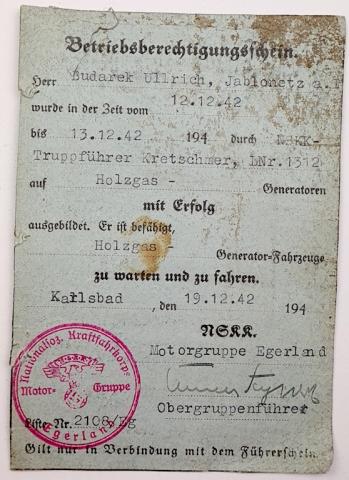
WW2 German Nazi NSKK driver's license ID with an original signature from a general of the NSDAP Obergruppenführer dated Karlsbad 1942

WW2 German Nazi NSKK driver's license ID with an original signature from a general of the NSDAP Obergruppenführer dated Karlsbad 1942

WW2 German Nazi NSKK driver's license ID with an original signature from a general of the NSDAP Obergruppenführer dated Karlsbad 1942

$85.00

Product

WW2 German Nazi NSKK driver's license ID with an original signature from a general of the NSDAP Obergruppenführer dated Karlsbad 1942

original signature, dated Karlsbad 1942. Apparently this is a driver's license for this unit, signed by the commander of the Motorgruppe Egerland (part of the SA, founded in 1930, later passed under the SS-according to the search engine) !! !! I do not promote anything, sale only for collectors' purposes. Added: 01.02.2022 07:04:56 So I specify, this is the signature of the Obergruppenführer of the National Socialist Motor Corps (NSKK), the National Socialist Automobile Corps was formed on April 20, 1931 from the National Socialist Automobile Corps (NSAK) and was raised in 1934 to become the third 'combat structure' of the NSDAP next to the SA and SS.

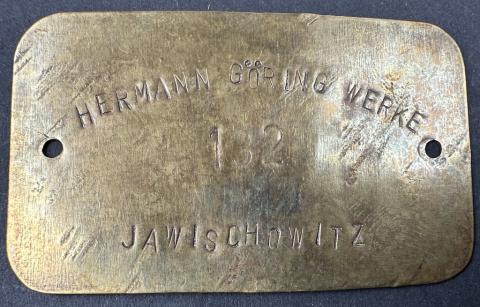
Holocaust Reichswerke Hermann Goring metal ID plate forced labour werke mining

Reichswerke Hermann Goring metal ID plate forced labour werke mining

Holocaust Reichswerke Hermann Goring metal ID plate forced labour werke mining

$85.00

Product

Reichswerke Hermann Goring metal ID plate forced labour werke mining

Reichswerke Hermann Göring ("Hermann Göring Reich Works") was an industrial conglomerate in Nazi Germany from 1937 until 1945. It was established to extract and process domestic iron ores from Salzgitter that were deemed uneconomical by the privately held steel mills. The state-owned Reichswerke was seen as a vehicle of hastening growth in ore mining and steel output regardless of private capitalists' plans and opinions, which ran in alignment to Adolf Hitler's strategic and economic vision. In November 1937, Reichsminister of Aviation Hermann Göring obtained unchecked access to state financing and launched a chain of mergers, diversifying into military industries with the absorption of Rheinmetall. Göring himself supervised the Reichswerke but did not own it in any sense and did not make personal profit from it directly, although at times he withdrew cash for personal expenses.

After the Anschluss, the Reichswerke absorbed Austrian heavy industries, including those owned by private German investors. The cluster of steel mills and supporting companies in Linz became its most important asset. Nazi leadership regarded captured assets as the property of the state and were not willing to share the spoils with German businesses. After the German occupation of Czechoslovakia, the Reichswerke absorbed between 50 and 60 per cent of Czech heavy industries. The pattern was repeated in occupied Poland, France and the Soviet Union. The Reichswerke operated captured assets as far from its base as Liepāja in Latvia and Donetsk in eastern Ukraine. It provided one-eighth of German steel output during the Second World War[6] and created a Nazi-controlled military complex that was independent of private interests. By the end of 1941 the Reichswerke became the largest company in Europe[8] and probably in the whole world, with a capital of 2.4 billion ℛ︁ℳ︁ and about half a million workers.

In 1942 the Reichswerke's inefficient corporate structure was reduced in size. Its weapons and munitions assets were integrated into the Ministry of Armaments; the mining and steel core of the Reichswerke continued operation under Goring's supervision until the end of the war, albeit at a loss. The conglomerate was dismembered by the Allies in 1944–1945, but the Salzgitter plant continued operations as Reichswerke until 1953. The Reichswerke logo, which resembled Göring's coat of arms, remained in use by Peine+Salzgitter until the middle of the 1980s.

Pages

Subscribe to RSS - ID SOLDBUCH WEHRPASS