Empty

Total: $0.00

WW2 German Nazi large plate about the battle of Narvik north Norwegian town of Narvik
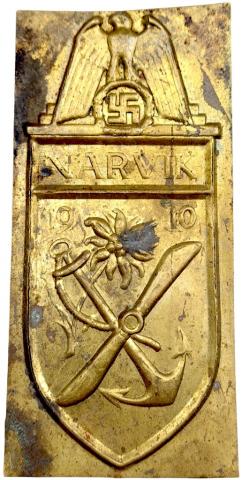
WW2 German Nazi large plate about the battle of Narvik north Norwegian town of Narvik

WW2 German Nazi large plate about the battle of Narvik north Norwegian town of Narvik

$79.00

Product

The Battles of Narvik were fought from 9 April to 8 June 1940, as a naval battle in the Ofotfjord and as a land battle in the mountains surrounding the north Norwegian town of Narvik, as part of the Norwegian Campaign of the Second World War.

The two naval battles in the Ofotfjord on 10 April and 13 April were fought between the British Royal Navy and Nazi Germany Kriegsmarine, while the two-month land campaign was fought between Norwegian, French, British, and Polish troops against German mountain troops, shipwrecked Kriegsmarine sailors and German paratroopers (Fallschirmjäger) from the 7th Air Division. Although defeated at sea off Narvik, losing control of the town of Narvik and being pushed back towards the Swedish border, the Germans eventually prevailed because of the Allied evacuation from Norway in June 1940 following the Battle of France.

Narvik provided an ice-free harbour in the North Atlantic for iron ore transported by rail from Kiruna in Sweden. Both sides in the war had an interest in securing this iron supply for themselves and denying it to the enemy, thereby setting the stage for one of the biggest battles since the Invasion of Poland.

Prior to the German invasion, British forces had considered Narvik as a possible landing point for an expedition to help Finland in the Winter War. Such an expedition also had the potential of taking control of the Swedish mines and opening up the Baltic for the Allies.

WW2 German Nazi large German-Polish-Ukrainian Poster by the WAFFEN SS POLICE about EXECUTIONS of resistance supporters RARE

WW2 German Nazi large German-Polish-Ukrainian Poster by the WAFFEN SS POLICE about EXECUTIONS of resistance supporters RARE

WW2 German Nazi large German-Polish-Ukrainian Poster by the WAFFEN SS POLICE about EXECUTIONS of resistance supporters RARE

$345.00

Product

WW2 German Nazi large German-Polish-Ukrainian Poster by the WAFFEN SS POLICE about EXECUTIONS of resistance supporters RARE

the poster is in 3 languages :

NOTICE!
(German section – main header and legal basis)

“By reason of crimes under §§ 1 and 2 of the regulation for combating attacks against the German reconstruction work in the General Government of October 2, 1943 (Official Gazette p. 843), and in connection with the regulation of November 10, 1939 concerning summary courts in the district of the Governor General, the following persons have been sentenced to death by a Summary Court (Standgericht):”

List of the condemned (names)

(Names and towns are listed — these are individuals sentenced to death.)

Kaminski Józef – from Przemyśl
Trojnar Ludwik – from Rudka
Lewicki Sergiusz – from Przemyśl
Polak Mieczysław – from Przemyśl
Sykata Tadeusz – from Przemyśl
Przybylski Stanisław – from Ujkowice
Kurzalewicz Józef – from Przemyśl
Thomas Stanisław – from Przemyśl
Rensch Stanisław – from Żurawica
Wiśniowski Władysław – from Przemyśl
Makowski Bronisław – from Przemyśl
Teluk Kazimierz – from Przemyśl
Kilar Czesław – from Przemyśl
Nebeski Lucjan – from Przemyśl
(continues…)
(up to 23 names total)
Execution notice

“The sentence has already been carried out on persons numbered 1–3.
Persons numbered 4–23 have been submitted for clemency consideration.”

Threat / warning to the population

“Should further attacks against German reconstruction work occur within the next three months in the district of Przemyśl, especially against members of the German armed forces or German authorities, or should assistance be given to such acts, then the death sentences of at least 10 of those submitted for clemency will be carried out.”

Call for cooperation (coercion)

“It is therefore in the interest of the non-German population to ensure, through immediate reporting or by influencing known perpetrators or suspects, that the sentence is not fully carried out.”

Signature

“The SS and Police Leader in the District of Kraków”

What this means in plain English

This is essentially saying:

These people were sentenced to death (some already executed)
Others are being kept alive temporarily as leverage
If any resistance activity continues, more will be executed
Civilians are pressured to inform, denounce, or stop resistance

WW2 German Nazi SCARCE Third Reich Leader MARTIN BORMANN enamel metal street PLATZ sign

WW2 German Nazi original Third Reich Leader MARTIN BORMANN enamel metal street PLATZ sign

WW2 German Nazi SCARCE Third Reich Leader MARTIN BORMANN enamel metal street PLATZ sign

$289.00

Product

WW2 German Nazi SCARCE Third Reich Leader MARTIN BORMANN enamel metal street PLATZ sign

VERY RARE SIGN TO FIND !

Martin Ludwig Bormann[2] (17 June 1900 – 2 May 1945) was a German Nazi Party official and head of the Nazi Party Chancellery, private secretary to Adolf Hitler, and a war criminal. Bormann gained immense power by using his position as Hitler's private secretary to control the flow of information and access to Hitler. He used his position to create an extensive bureaucracy and involve himself as much as possible in the decision making.

Bormann joined a paramilitary Freikorps organisation in 1922 while working as manager of a large estate. He served nearly a year in prison as an accomplice to his friend Rudolf Höss (later commandant of Auschwitz concentration camp) in the murder of Walther Kadow. Bormann joined the Nazi Party in 1927 and the Schutzstaffel (SS) in 1937. He initially worked in the party's insurance service, and transferred in July 1933 to the office of Deputy Führer Rudolf Hess, where he served as chief of staff.

Bormann gained acceptance into Hitler's inner circle and accompanied him everywhere, providing briefings and summaries of events and requests. He was appointed as Hitler's personal secretary on 12 April 1943.[3] After Hess's solo flight to Britain on 10 May 1941 to seek peace negotiations with the British government, Bormann assumed Hess's former duties, with the title of Head of the Parteikanzlei (Party Chancellery). He had final approval over civil service appointments, reviewed and approved legislation, and by 1943 had de facto control over all domestic matters. Bormann was one of the leading proponents of the ongoing persecution of the Christian churches and favoured harsh treatment of Jews and Slavs in the areas conquered by Germany during World War II.

Bormann returned with Hitler to the Führerbunker in Berlin on 16 January 1945 as the Red Army approached the city. After Hitler committed suicide, Bormann and others attempted to flee Berlin on 2 May to avoid capture by the Soviets. Bormann probably committed suicide on a bridge near Lehrter station. His body was buried nearby on 8 May 1945, but was not found and confirmed as Bormann's until 1973; the identification was reaffirmed in 1998 by DNA tests. The missing Bormann was tried in absentia by the International Military Tribunal in the Nuremberg trials of 1945 and 1946. He was convicted of war crimes and crimes against humanity and sentenced to death by hanging.

WW2 German Nazi large German Poster by the WAFFEN SS POLICE about EXECUTIONS of 10 Polish as a reprisal for the killing of a German police officer

WW2 German Nazi large German Poster by the WAFFEN SS POLICE about EXECUTIONS of 10 Polish as a reprisal for the killing of a German police officer

WW2 German Nazi large German Poster by the WAFFEN SS POLICE about EXECUTIONS of 10 Polish as a reprisal for the killing of a German police officer

$389.00

Product

WW2 German Nazi large German Poster by the WAFFEN SS POLICE about EXECUTIONS of 10 Polish as a reprisal for the killing of a German police officer

This poster is an official German occupation notice issued in Kraków on April 6, 1944, by the SS and police authorities.

It announces that 10 Poles were executed as a reprisal for the killing of a German police officer. The executions are described as a direct response ordered by a German summary court (Standgericht), which means the sentences were carried out quickly, without a normal trial.

The central part of the poster contains a long list of over 100 names of Polish prisoners. According to the text, these individuals were sentenced to death, and the notice states that some of these executions have already been carried out. This public listing of names was meant to show that many more people could be killed at any time.

The poster also emphasizes that these punishments were carried out under German law and authority, referencing decrees related to combating resistance and protecting the occupying forces.
Martin
This is a World War II occupation-era poster printed on green paper, issued by the German authorities (SS and police) in Kraków in 1944.

The layout is divided into two vertical sections with large, bold headlines:

On the left, in German, the headline “BEKANNTMACHUNG!” (“Announcement!”) appears in large black letters.
On the right, in Polish, the equivalent “OBWIESZCZENIE!” is printed, also in bold.

Below each headline, the text explains punitive measures taken by the Nazi authorities. The German and Polish texts mirror each other, addressing both populations.

Content summary:

The poster announces executions and repression carried out by the German occupation forces.
It states that members of the Polish population (including intellectuals and resistance supporters) have been arrested and shot.
The text justifies these actions as retaliation for acts of resistance, sabotage, or attacks against German forces.
It serves as a warning that further acts against the occupiers will result in collective punishment and more executions.
At the bottom, it is signed by “Der SS- und Polizeiführer im Distrikt Krakau” (SS and Police Leader in the Kraków district), emphasizing authority and intimidation.

Visual characteristics:

The use of green paper and black print makes it highly visible in public spaces.
The typography is stark and official, designed to convey authority and fear.
The bilingual format ensures both German officials and the occupied Polish population understand the message.

Purpose:
This type of poster was used as a tool of terror and control, aiming to intimidate civilians, discourage resistance, and demonstrate the power of the occupying Nazi regime.

Pages

Subscribe to RSS - Nazi panels and boards