Empty

Total: $0.00

EARLY COTTON NSDAP SWASTIKA TUNIC REMOVED BROWN SHIRT ARMBAND

EARLY COTTON NSDAP SWASTIKA TUNIC REMOVED BROWN SHIRT ARMBAND

EARLY COTTON NSDAP SWASTIKA TUNIC REMOVED BROWN SHIRT ARMBAND

$135.00

Product

EARLY COTTON NSDAP SWASTIKA TUNIC REMOVED BROWN SHIRT ARMBAND

STAINS

The Sturmabteilung (SA; German pronunciation: [ˈʃtʊɐ̯mʔapˌtaɪlʊŋ] (About this soundlisten)), literally "Storm Detachment", was the Nazi Party's original paramilitary wing. It played a significant role in Adolf Hitler's rise to power in the 1920s and 1930s. Its primary purposes were providing protection for Nazi rallies and assemblies; disrupting the meetings of opposing parties; fighting against the paramilitary units of the opposing parties, especially the Roter Frontkämpferbund of the Communist Party of Germany (KPD) and the Reichsbanner Schwarz-Rot-Gold of the Social Democratic Party of Germany (SPD); and intimidating Romani, trade unionists, and especially Jews.

The SA were colloquially called Brownshirts (Braunhemden) because of the colour of their uniform's shirts, similar to Benito Mussolini's blackshirts. The official uniform of the SA was the brown shirt with a brown tie. The color came about because a large shipment of Lettow-shirts, originally intended for the German colonial troops in Germany's former East Africa colony,[2] was purchased in 1921 by Gerhard Roßbach for use by his Freikorps paramilitary unit. They were later used for his Salzburg Schill Youth and in 1924 were adopted by the Schill Youth in Germany.[3] The "Schill Sportversand" then became the main supplier for the SA brown shirts. The SA developed pseudo-military titles for its members, with ranks that were later adopted by several other Nazi Party groups, chief amongst them the Schutzstaffel (SS), which originated as a branch of the SA before it was separated from it after the Night of the Long Knives.

After Adolf Hitler ordered the Night of the Long Knives (die Nacht der langen Messer) in 1934, he withdrew his support for the SA. The SA continued to exist but had lost almost all its influence, and was effectively superseded by the SS, which had carried out Hitler's orders in the purge, and thereafter was formally removed from the SA. The SA remained in existence until after Nazi Germany's final capitulation to the Allies in 1945, after which it was disbanded and outlawed by the Allied Control Council.
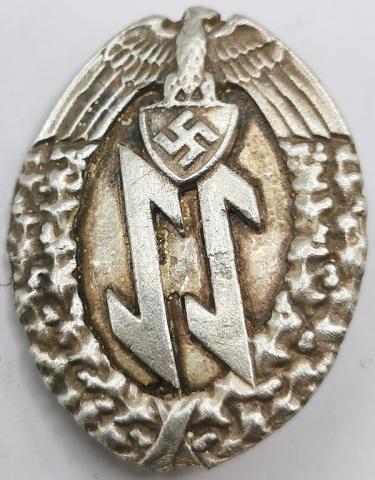
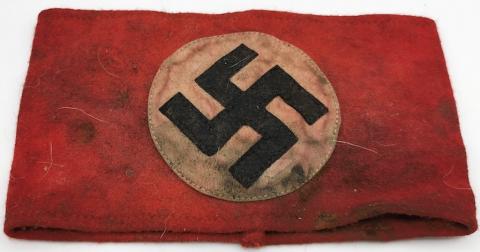
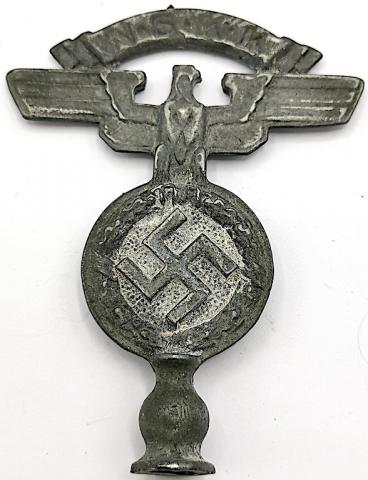
NSKK N.S.K.K POLE TOP OF FLAG FROM CAR PENNANT RELIC FOUND MOTORCYCLE CLUB

NSKK N.S.K.K POLE TOP OF FLAG FROM CAR PENNANT RELIC FOUND MOTORCYCLE CLUB

NSKK N.S.K.K POLE TOP OF FLAG FROM CAR PENNANT RELIC FOUND MOTORCYCLE CLUB

$125.00

Product

NSKK N.S.K.K POLE TOP OF FLAG FROM CAR PENNANT RELIC FOUND MOTORCYCLE CLUB

The National Socialist Motor Corps (German: Nationalsozialistisches Kraftfahrkorps, NSKK)[1] was a paramilitary organization of the Nazi Party (NSDAP) that officially existed from May 1931 to 1945. The group was a successor organisation to the older National Socialist Automobile Corps (NSAK), which had existed since April 1930.

The NSKK served as a training organization, mainly instructing members in the operation and maintenance of high-performance motorcycles and automobiles. The NSKK was further used to transport NSDAP and SA officials/members. The NSKK also served as a roadside assistance group in the mid-1930s, comparable to the modern-day American Automobile Association or the British Automobile Association. The outbreak of World War II in Europe caused the NSKK ranks to be recruited to serve in the transport corps of various German military branches. There was also a French section of the NSKK, which was organised after the German occupation of France began in 1940. The NSKK was the smallest of the Nazi Party organizations.

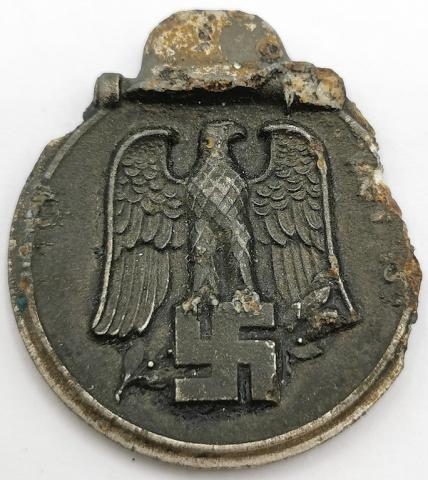
EASTERN FRONT OST MEDAL WINTERSCHLACHT AWARD SOVIET BATTLE RELIC BATTLEFIELD FOUND Ostmedaille

EASTERN FRONT OST MEDAL WINTERSCHLACHT AWARD SOVIET BATTLE RELIC BATTLEFIELD FOUND Ostmedaille

EASTERN FRONT OST MEDAL WINTERSCHLACHT AWARD SOVIET BATTLE RELIC BATTLEFIELD FOUND Ostmedaille

$50.00

Product

EASTERN FRONT OST MEDAL WINTERSCHLACHT AWARD SOVIET BATTLE RELIC BATTLEFIELD FOUND Ostmedaille

FOUND IN BATTLEFIELD IN RUSSIA

The Eastern Medal (German: Ostmedaille), officially the Winter Battle in the East 1941–42 Medal (German: Medaille Winterschlacht im Osten 1941/42), was a military award of the Wehrmacht which was created by ordinance of Adolf Hitler on 26 May 1942.[1]

The Eastern Medal was awarded to any member of the Wehrmacht and Waffen-SS "in recognition of experience in the struggle against the Bolshevik enemy and the Russian winter within the period from 15 November 1941 to 15 April 1942." It was also awarded posthumously to any service member who died in the line of duty within the Soviet Union.[2] It was wryly called the Frozen Meat Medal or the "Order of the Frozen Flesh" (German: Gefrierfleischorden).

THIRD REICH SOCIAL WELFARE MEDAL MEDICAL NSDAP AWARD RELIC GROUND DUG FOUND

THIRD REICH SOCIAL WELFARE MEDAL MEDICAL NSDAP AWARD RELIC GROUND DUG FOUND

THIRD REICH SOCIAL WELFARE MEDAL MEDICAL NSDAP AWARD RELIC GROUND DUG FOUND

$50.00

Product

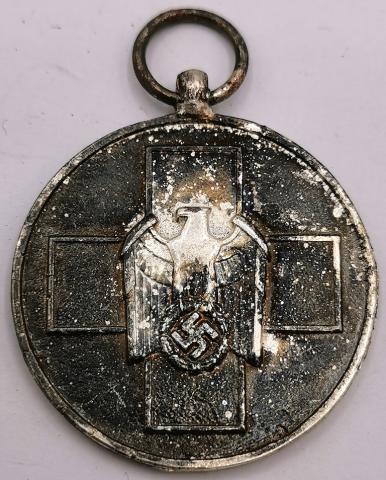
THIRD REICH SOCIAL WELFARE MEDAL MEDICAL NSDAP AWARD RELIC GROUND DUG FOUND

The Social Welfare Decoration (German: Ehrenzeichen für deutsche Volkspflege) was a German Civil Award created by Adolf Hitler on 1 May 1939 for services in the social sector. The decoration was issued in three classes and was awarded for a wide variety of service, in the social sector, to the German state. Qualifying service would have been with Winterhilfswerk, National Socialist People's Welfare, medical and rescue work, or care of foreign and ethnic Germans. As a replacement for the German Red Cross Decoration, it was conferred in four classes consisting of a white-enameled gold Balkenkreuz with Reich eagle and swastika. A "Medal of Social Welfare" was also issued for lesser degrees of service, not warranting the higher presentation of a class award.

The main requirement for the award was that the service rendered should be to the benefit of the civil population. Reinhard Heydrich was awarded the decoration for his running of the Gestapo in the 1930s and for providing "security" to the German people. The infamous Doctor Josef Mengele was also awarded the decoration in 1941, for providing medical services to wounded soldiers and civilians alike on the battlefields of the Eastern Front.

EASTERN FRONT OST MEDAL WINTERSCHLACHT AWARD SOVIET BATTLE RELIC BATTLEFIELD FOUND Ostmedaille

EASTERN FRONT OST MEDAL WINTERSCHLACHT AWARD SOVIET BATTLE RELIC BATTLEFIELD FOUND Ostmedaille

EASTERN FRONT OST MEDAL WINTERSCHLACHT AWARD SOVIET BATTLE RELIC BATTLEFIELD FOUND Ostmedaille

$50.00

Product

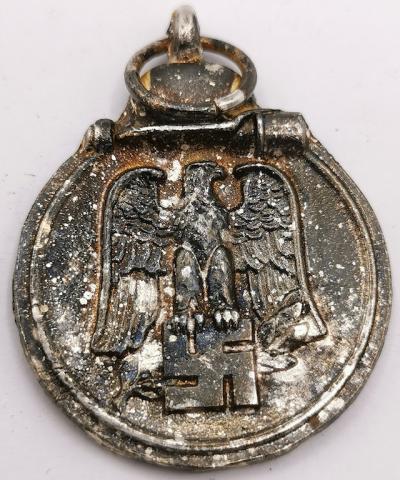
EASTERN FRONT OST MEDAL WINTERSCHLACHT AWARD SOVIET BATTLE RELIC BATTLEFIELD FOUND Ostmedaille

FOUND IN BATTLEFIELD IN RUSSIA

The Eastern Medal (German: Ostmedaille), officially the Winter Battle in the East 1941–42 Medal (German: Medaille Winterschlacht im Osten 1941/42), was a military award of the Wehrmacht which was created by ordinance of Adolf Hitler on 26 May 1942.[1]

The Eastern Medal was awarded to any member of the Wehrmacht and Waffen-SS "in recognition of experience in the struggle against the Bolshevik enemy and the Russian winter within the period from 15 November 1941 to 15 April 1942." It was also awarded posthumously to any service member who died in the line of duty within the Soviet Union.[2] It was wryly called the Frozen Meat Medal or the "Order of the Frozen Flesh" (German: Gefrierfleischorden).

INFANTRY ASSAULT BADGE MEDAL AWARD IN SILVER MARKED WEHRMACHT WAFFEN SS

INFANTRY ASSAULT BADGE MEDAL AWARD IN SILVER MARKED WEHRMACHT WAFFEN SS MILITARIA DEALER

INFANTRY ASSAULT BADGE MEDAL AWARD IN SILVER MARKED WEHRMACHT WAFFEN SS

$75.00

Product

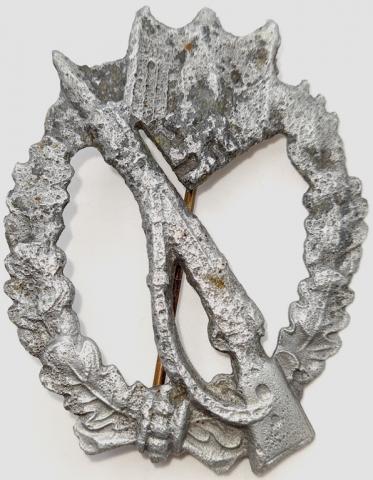
INFANTRY ASSAULT BADGE MEDAL AWARD IN SILVER MARKED WEHRMACHT WAFFEN SS

RELIC GROUND DUG FIND
MAKER MARKED WELL VISIBLE ON THE BACK

The Infantry Assault Badge (German: Infanterie-Sturmabzeichen) was a German war badge awarded to Waffen-SS and Wehrmacht Heer soldiers during the Second World War. This decoration was instituted on 20 December 1939 by the Commander-in-Chief of the German Army, Generalfeldmarschall Walther von Brauchitsch. It could be awarded to members of non-motorized Infantry units and units of the Gebirgsjäger that had participated in infantry assaults, with light infantry weapons, on at least three separate days of battle in the front line on or after 1 January 1940. When a counter offensive led to fighting, it could also apply. Award of the Infantry Assault Badge was authorized at regimental command level.

WW2 GERMAN NAZI ORDER OF THE GERMAN EAGLE MEDAL AWARD FROM THE BOMBING OF ZIMMERMANN FACTORY

WW2 GERMAN ORIGINAL FOR SALE ORDER OF THE GERMAN EAGLE MEDAL AWARD ZIMMERMANN

WW2 GERMAN NAZI ORDER OF THE GERMAN EAGLE MEDAL AWARD FROM THE BOMBING OF ZIMMERMANN FACTORY

$375.00

Product

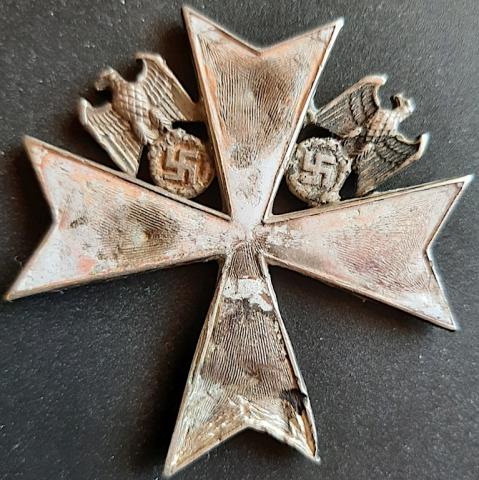
WW2 GERMAN NAZI ORDER OF THE GERMAN EAGLE MEDAL AWARD FROM THE BOMBING OF ZIMMERMANN FACTORY

SEE LAST PHOTO OF AN EXAMPLE FROM THE SAME FOUND, SOLD FOR 1150 EUROS (OVER 1300$)

THIS IS ONE OF THE GREATEST GERMANY AWARD!
VERY EXPENSIVE SO THIS IS YOUR CHANCE TO OWN ONE FOR AN AFFORDABLE PRICE.

Zimmermann was a well known German manufacturer of a great variety of awards, German as well as International, that was destroyed in an allied bombing raid in the early 1940's on Pforzheim, Germany. Sometime during the 1990's, during construction on the former factory site, a quantity of medals was discovered (about 50 kilos). Some were in good condition, but most of the pieces exhibited fire damage, or were rusted. Hundreds of pieces were partially finished, and some items were just medal parts, as one would expect to be found in the factory.

Pages

Subscribe to RSS - items with Swastika