WW2 German Nazi manual user guide for gun Walther P-38
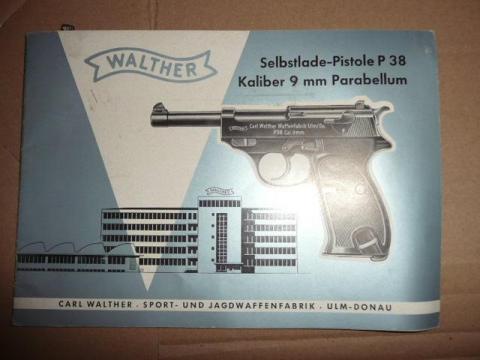
WW2 German Nazi manual user guide for gun Walther P-38
$79.00
Product
WW2 German Nazi manual user guide for gun Walther P-38
Empty
WW2 German Nazi manual user guide for gun Walther P-38
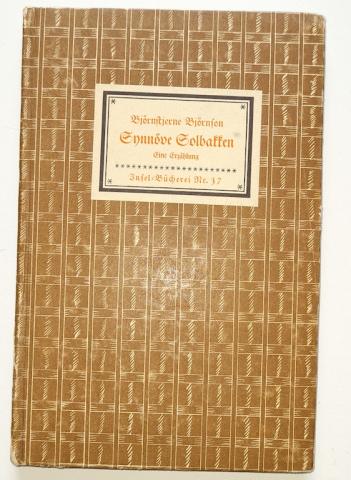
Original book from the Waffen-SS Artillery regiment library stamped dated 1939
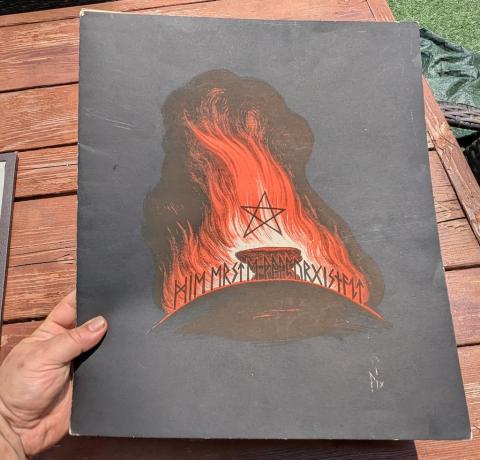
CREATION OF THE WAFFEN SS by HIMMLER - large BOOK with ORIGINAL HEINRICH HIMMLER HANDMADE SIGNATURE with COA
comes with a hard cover flip protective pouch
WHERE IT ALL BEGAN!!
When Himmler created the SS and all that comes around (the old runes, the basic provenance) it took his inspiration from that book!
only 350 were made, i am pretty sure less than 5 still exists !!
and you have on the first page, an amazing HANDMADE original signature of HIMMLER!
this is a top museum quality stuff!
it comes with a valid certificate of authenticity for the signature.
also comes with a hard cover flip protection with a silver third reich eagle on it.
Die erste Walpurgisnacht
The First Walpurgis Night / by Johann Wolfgang von Goethe. Drawn on stone by Otto Pech, Altenburg. [Accompanying text: Pix] ; Lithograph by the Kunstanstalt vorm. Schneider u. Co. Altenburg i. Trier
Title: The first Walpurgis Night / by Johann ...
Publisher: Bad Harzburg
Publication date: 1924
Cover: 41 x 35 cm [folder]
Condition: Very good
Edition: 350 copies
about the book :
Mendelssohn's Die erste Walpurgisnacht (The First Walpurgis Night) , based on a text by Goethe, is a work fraught with ambiguities and paradoxes. It is a major work by the composer that should not be overlooked in any serious discussion of Mendelssohn's life and work. Nevertheless, the piece has never been published in a source-critical edition. The first editions, carefully curated by Mendelssohn himself, were replaced by others that gradually corrupted the musical text of the work.
we know Walpurgis Night as a nightly spring feast based on the more or less fantastical notion of a witches' sabbath. In mythology and history, it is also closely associated with the peak of the Brocken, the highest mountain in the Harz Mountains. Today's concertgoers are generally unaware that for Goethe, Mendelssohn, and their contemporaries, that night was a predetermined celebration, evoking centuries of strife, conflict, mystery, and violence. Essentially, it was about religious intolerance and the murky boundaries between the natural and the supernatural, the boundaries between certainties and what we cannot know.
The genesis of Mendelssohn's cantata can essentially be divided into two periods. The first, spanning the years 1830 to 1833, produced a complete musical setting, which premiered successfully in Berlin under the composer's direction and was initially intended for publication but ultimately not. During the later 1830s, Mendelssohn became increasingly dissatisfied with this setting, and after 1840 he revised the work again. The revisions developed a life of their own, becoming increasingly extensive the more attention the composer devoted to the project. Subsequently, the revisions that the revised version had undergone before the premiere in February 1843 were expanded even further while the printing of the piano reduction was in preparation. Between the publication of the piano reduction in late 1843 and the printing of the score in the spring of 1844, further substantial changes were made.
"(In the last days of paganism in Germany, Christians forbade Druid sacrifices under penalty of death. Despite this, the Druids and the people sought to conquer the mountain heights at the beginning of spring, offer their sacrifices there, and intimidate and drive away the Christian warriors (usually through their fear of the devil). The legend of the first Walpurgis Night is said to be based on such attempts.)"
It will come as no surprise to anyone familiar with Mendelssohn's self-critical attitude and his tendency to withhold many important compositions that "The First Walpurgis Night" also underwent numerous revisions between its premiere and publication. More surprising, however, is that in the published score, the composer replaced the introduction with an excerpt from a letter from Goethe dated September 9, 1831. In doing so, he weakened the literary-historical subject of the work in favor of a more overarching symbolism. The new introduction reads:
"For it must continually repeat itself in world history that something old, established, tested, and reassuring is pushed, pushed, displaced, and, if not eradicated, at least crammed into the narrowest possible space by emerging innovations. The middle period, when hatred can and may still counteract, is portrayed here succinctly enough, and a joyful, indestructible enthusiasm flares up once more in splendor and clarity. You have certainly given life and meaning to all this, and so may it also flourish for my joyful enjoyment."
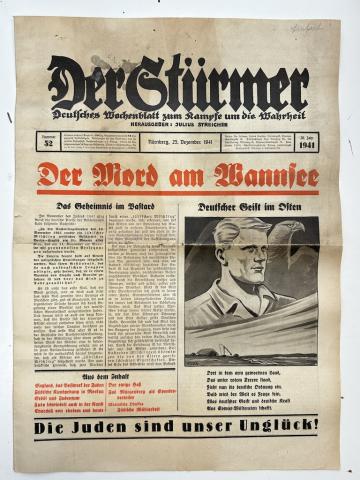
Most infamous antisemitic anti Jew Jewish Der Sturmer magazine christmas 1941
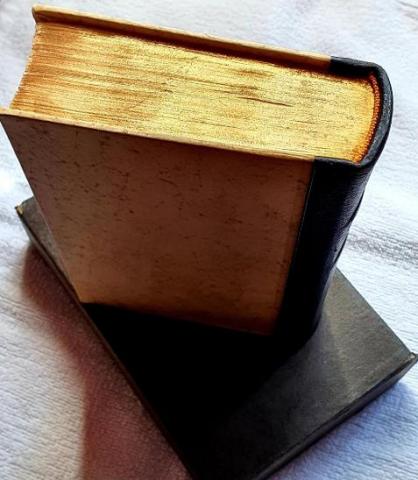
Adolf Hitler Mein Kampf wedding edition book with GOLD pages and BOX RARE
Beautifully flawless condition of a well-known book from 1936
rare updated variation with gold on the top of the book (see pages) - was for high rank officer weeding gift.
comes with the original box of issue which is very rare
amazing piece of history!

VERY RARE BOOKS
Uncommon books in German: XI. Olympiade Berlin 1936: Amtlicher Bericht, Volumes I and II [The XIth Olympic Games, Berlin, 1936: Official Report]. Berlin: Wilhelm Limpert, 1937. Hardcovers bound in original white cloth with gilt decorations, 9.5 x 12.25, totaling 1222 pages. Book condition: VG-/None, with rubbing and minor staining to boards, foxing to endpapers, and minor tears and creasing to some interior pages.
First Edition, Illustrated, Publishers' Original Binding, Very Scarce
The full official report of the 1936 Berlin Olympic Games, issued by the German Olympic Committee. With a wealth of significant photographs, this very scarce work is perhaps the most extensive record of the 1936 Olympics, covering the history of the event, the venues, the opening ceremony, the event's proceedings, as well as medal tables and the results of each event. For many, the Berlin Olympics bring to mind the achievements of Jesse Owens, who won four gold medals in the face of Hitler's attempts to use the games to promote ideas of racial supremacy and antisemitism. The initial pages of the work include full-page portraits of prominent leaders of the Third Reich including Adolf Hitler and Hermann Goerring, captioned by quotations. Purple stamp from Stallag VIII-B to the title page of both volumes. Stalag VIII-B near Lamsdorf in Eastern Germany was originally, from 1860, a Prussian training camp. It served as a prisoner of war camp first in the Franco-Prussian war and later as a POW camp in World War One. In 1939 it was reopened to house Polish prisoners. Though later it housed prisoners from all the allied nations including from 1944 the overflow from Stalag Luft III after the famous 'great escape' of 1943. It had an extensive library (as did Stalg Luft III) and this copy comes from that library. Blind stamp of the Imperial eagle clutching the Olympic rings to the front endpaper of both volumes. Captioned by the motto of the 1936 Olympic Games, 'Ich rufe di Jugend der Welt', which translates to 'I summon the youth of the world'. Undated. Dated using estimations from the University of Birmingham Library.

Adolf Hitler PERSONAL LIBRARY in BERGHOF stamped book AH Fuhrer belongings
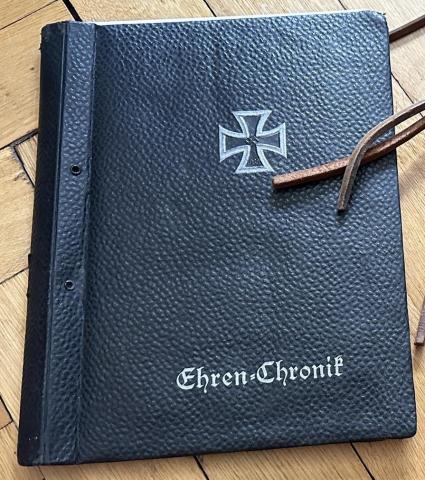
WW2 German Nazi Wehmacht officer meetin folder book with papers Iron Cross Swastika
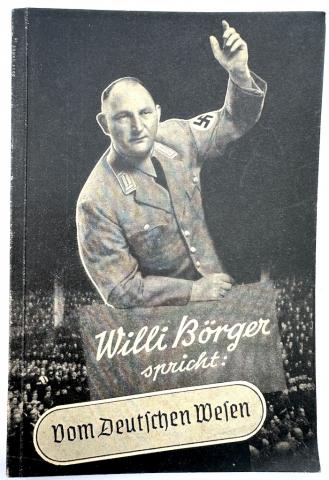
WW2 German Nazi WAFFEN SS NSDAP Leader Wilhelm Börger personal book Vom deutschen Wesen.
Wilhelm Heinrich Börger (14 February 1896 – 29 June 1962) was a German Nazi Party functionary and SS-Brigadeführer. He held several administrative positions, including as a Trustee of Labour and a Ministerial Director in the Reich Ministry of Labor. He also sat as a member of the Reichstag and the Prussian State Council. Following the defeat of Nazi Germany in the Second World War, he was interned for three years and released.

WW2 German Nazi NSDAP Fuhrer Adolf Hitler personal book MEIN KAMPF Wedding edition - one page is missing at the beginning
