Empty

Total: $0.00

WAFFEN SS 14TH PANZER GRENADIER DIVISION GALIZIEN GALIZIA UKRAINIAN SILVER RING
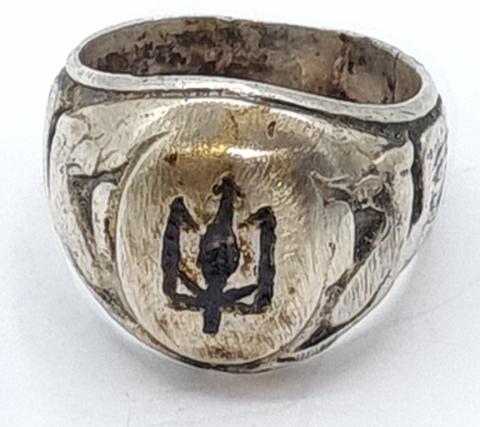
WAFFEN SS 14TH PANZER GRENADIER DIVISION GALIZIEN GALIZIA UKRAINIAN SILVER RING

WAFFEN SS 14TH PANZER GRENADIER DIVISION GALIZIEN GALIZIA UKRAINIAN SILVER RING

$275.00

Product

WAFFEN SS 14TH PANZER GRENADIER DIVISION GALIZIEN GALIZIA UKRAINIAN SILVER RING

UNIQUE !

The 14th Waffen Grenadier Division of the SS (1st Galician) (German: 14. Waffen-Grenadier-Division der SS [galizische Nr. 1], Ukrainian: 14а Гренадерська Дивізія СС (1а галицька)), prior to 1944 titled the 14th SS-Volunteer Division "Galicia" (German: 14. SS-Freiwilligen Division "Galizien", Ukrainian: 14а Добровільна Дивізія СС "Галичина")[1] was a World War II German military formation made up predominantly of military volunteers with a Ukrainian ethnic background from the area of Galicia, later also with some Slovaks and Czechs. Formed in 1943, it was largely destroyed in the battle of Brody, reformed, and saw action in Slovakia, Yugoslavia and Austria before being renamed the first division of the Ukrainian National Army and surrendering to the Western Allies by 10 May 1945.
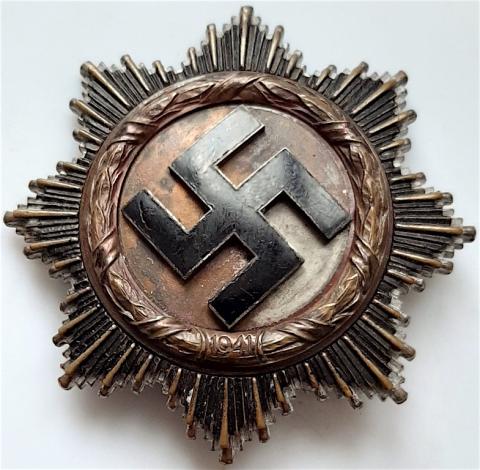
WW2 GERMAN NAZI WAR ORDER OF THE GERMAN CROSS IN GOLD MEDAL AWARD BY 134 OTTO KLEIN

WAR ORDER GERMAN CROSS GOLD MEDAL AWARD 134 OTTO KLEIN ORIGINAL

WW2 GERMAN NAZI WAR ORDER OF THE GERMAN CROSS IN GOLD MEDAL AWARD BY 134 OTTO KLEIN

$795.00

Product

WW2 GERMAN NAZI WAR ORDER OF THE GERMAN CROSS IN GOLD MEDAL AWARD BY 134 OTTO KLEIN

maker 134 - OTTO KLEIN
the back pin is missing.
with the back pin, these sells for 2500-3000 ...

it's one of the best german award ever made and it's a must to have this in any serious german WW2 collection

The War Order of the German Cross (German: Kriegsorden des Deutsches Kreuz), normally abbreviated to the German Cross or Deutsches Kreuz, was instituted by Adolf Hitler on 28 September 1941. It was awarded in two divisions: in gold for repeated acts of bravery or military leadership; and in silver for distinguished non-combat war service. The German Cross in Gold ranked higher than the Iron Cross First Class but below the Knight's Cross of the Iron Cross, while the German Cross in Silver ranked higher than the War Merit Cross First Class with Swords but below the Knight's Cross of the War Merit Cross with Swords.

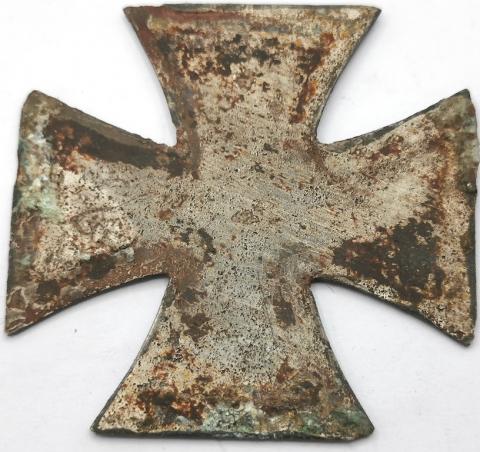
IRON CROSS 1ST CLASS MEDAL AWARD BACK PLATE RELIC FOUND WEHRMACHT WAFFEN SS

IRON CROSS 1ST CLASS MEDAL AWARD BACK PLATE RELIC FOUND WEHRMACHT WAFFEN SS

IRON CROSS 1ST CLASS MEDAL AWARD BACK PLATE RELIC FOUND WEHRMACHT WAFFEN SS

$25.00

Product

IRON CROSS 1ST CLASS MEDAL AWARD BACK PLATE WEHRMACHT WAFFEN SS

RELIC GROUND DUG FOUND

The Iron Cross (German: Eisernes Kreuz, abbreviated EK) was a military decoration in the Kingdom of Prussia, and later in the German Empire (1871–1918) and Nazi Germany (1933–1945). King Frederick William III of Prussia established it on 17 March 1813 during the Napoleonic Wars (EK 1813). The award was backdated to the birthday (10 March) of his late wife, Queen Louise. Louise was the first person to receive this decoration (posthumously). The recommissioned Iron Cross was also awarded during the Franco-Prussian War (EK 1870), World War I (EK 1914), and World War II (EK 1939). The Iron Cross awarded during World War II has a swastika in the center. The Iron Cross was usually a military decoration only, though there were instances awarded to civilians for performing military functions, such as Hanna Reitsch, who received the Iron Cross 2nd Class and Iron Cross 1st Class, and Melitta Schenk Gräfin von Stauffenberg, who received the Iron Cross, 2nd Class, civilian test pilots during World War II.

The cross symbol's design was black with a white or silver outline, was ultimately derived from the cross pattée of the Teutonic Order, used by knights on occasions from the 13th century.

The Prussian Army black crosses pattée was also used as the symbol of the succeeding German Army from 1871 to March–April 1918, when the Balkenkreuz replaced it. In 1956, it was re-introduced as the symbol of the Bundeswehr, the modern German armed forces (with the "ends" of the white border removed, as in the Balkenkreuz of 1918).

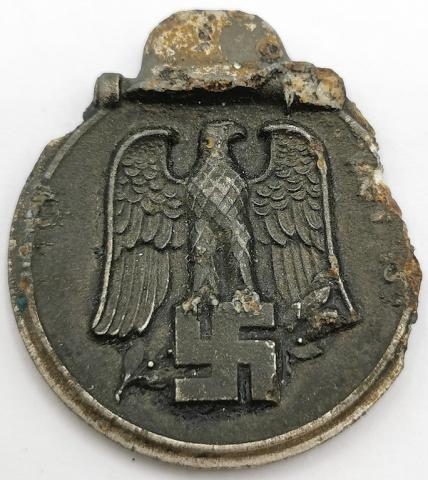
EASTERN FRONT OST MEDAL WINTERSCHLACHT AWARD SOVIET BATTLE RELIC BATTLEFIELD FOUND Ostmedaille

EASTERN FRONT OST MEDAL WINTERSCHLACHT AWARD SOVIET BATTLE RELIC BATTLEFIELD FOUND Ostmedaille

EASTERN FRONT OST MEDAL WINTERSCHLACHT AWARD SOVIET BATTLE RELIC BATTLEFIELD FOUND Ostmedaille

$50.00

Product

EASTERN FRONT OST MEDAL WINTERSCHLACHT AWARD SOVIET BATTLE RELIC BATTLEFIELD FOUND Ostmedaille

FOUND IN BATTLEFIELD IN RUSSIA

The Eastern Medal (German: Ostmedaille), officially the Winter Battle in the East 1941–42 Medal (German: Medaille Winterschlacht im Osten 1941/42), was a military award of the Wehrmacht which was created by ordinance of Adolf Hitler on 26 May 1942.[1]

The Eastern Medal was awarded to any member of the Wehrmacht and Waffen-SS "in recognition of experience in the struggle against the Bolshevik enemy and the Russian winter within the period from 15 November 1941 to 15 April 1942." It was also awarded posthumously to any service member who died in the line of duty within the Soviet Union.[2] It was wryly called the Frozen Meat Medal or the "Order of the Frozen Flesh" (German: Gefrierfleischorden).

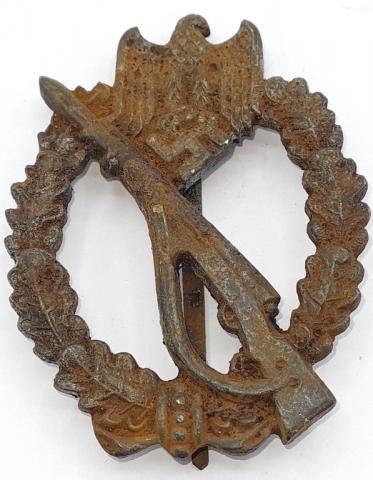
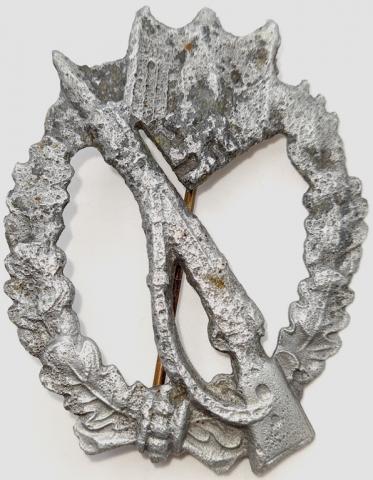
INFANTRY ASSAULT BADGE MEDAL AWARD IN SILVER MARKED WEHRMACHT WAFFEN SS

INFANTRY ASSAULT BADGE MEDAL AWARD IN SILVER MARKED WEHRMACHT WAFFEN SS MILITARIA DEALER

INFANTRY ASSAULT BADGE MEDAL AWARD IN SILVER MARKED WEHRMACHT WAFFEN SS

$75.00

Product

INFANTRY ASSAULT BADGE MEDAL AWARD IN SILVER MARKED WEHRMACHT WAFFEN SS

RELIC GROUND DUG FIND
MAKER MARKED WELL VISIBLE ON THE BACK

The Infantry Assault Badge (German: Infanterie-Sturmabzeichen) was a German war badge awarded to Waffen-SS and Wehrmacht Heer soldiers during the Second World War. This decoration was instituted on 20 December 1939 by the Commander-in-Chief of the German Army, Generalfeldmarschall Walther von Brauchitsch. It could be awarded to members of non-motorized Infantry units and units of the Gebirgsjäger that had participated in infantry assaults, with light infantry weapons, on at least three separate days of battle in the front line on or after 1 January 1940. When a counter offensive led to fighting, it could also apply. Award of the Infantry Assault Badge was authorized at regimental command level.

Pages

Subscribe to RSS - Grossdeutschland Panzer Grenadier